
Professor Wang Rending’s team from the First Hospital of Zhejiang University discovered a new marker for monitoring BKV nephropathy: simultaneous measurement of urine and plasma dd-cfDNA can assist in the adjustment of immunosuppressants in kidney transplant patients
Professor Wang Rending’s team from the First Affiliated Hospital of Zhejiang University School of Medicine has recently made important scientific research breakthroughs. A prospective cohort study conducted by the team showed that the dynamic changes of donor-derived cell-free DNA (dd-cfDNA) in urine and plasma may be a promising tool for monitoring BK polyomavirus-associated nephropathy (BKVAN) in kidney transplant recipients&n
Important progress has been made in non-invasive monitoring in the field of kidney transplantation
Professor Wang Rending’s team from the First Affiliated Hospital of Zhejiang University School of Medicine has recently made important scientific research breakthroughs. A prospective cohort study conducted by the team showed that the dynamic changes of donor-derived cell-free DNA (dd-cfDNA) in urine and plasma are expected to become a new non-invasive biomarker for monitoring the treatment response of BK polyomavirus-associated nephropathy (BKVAN) in kidney transplant recipients, providing a key basis for precise clinical adjustment of immunosuppression regimens.Relevant research results were published in "Renal Failure" journal 。
BKVAN monitoring challenges and the potential of dd-cfDNA
BKVAN is one of the major causes of graft injury and dysfunction after kidney transplantation. Existing BKVAN monitoring methods (such as BKV blood test and tissue biopsy) have limitations in sensitivity, invasiveness and timing. As a non-invasive biomarker, dd-cfDNA can reflect the status of the graft in real time due to its short half-life. It can simultaneously monitor/differentially diagnose rejection and BKV injury during the BKVAN medication adjustment process, and provide a non-invasive diagnostic basis for the timing of drug adjustment.
Research design and results highlights
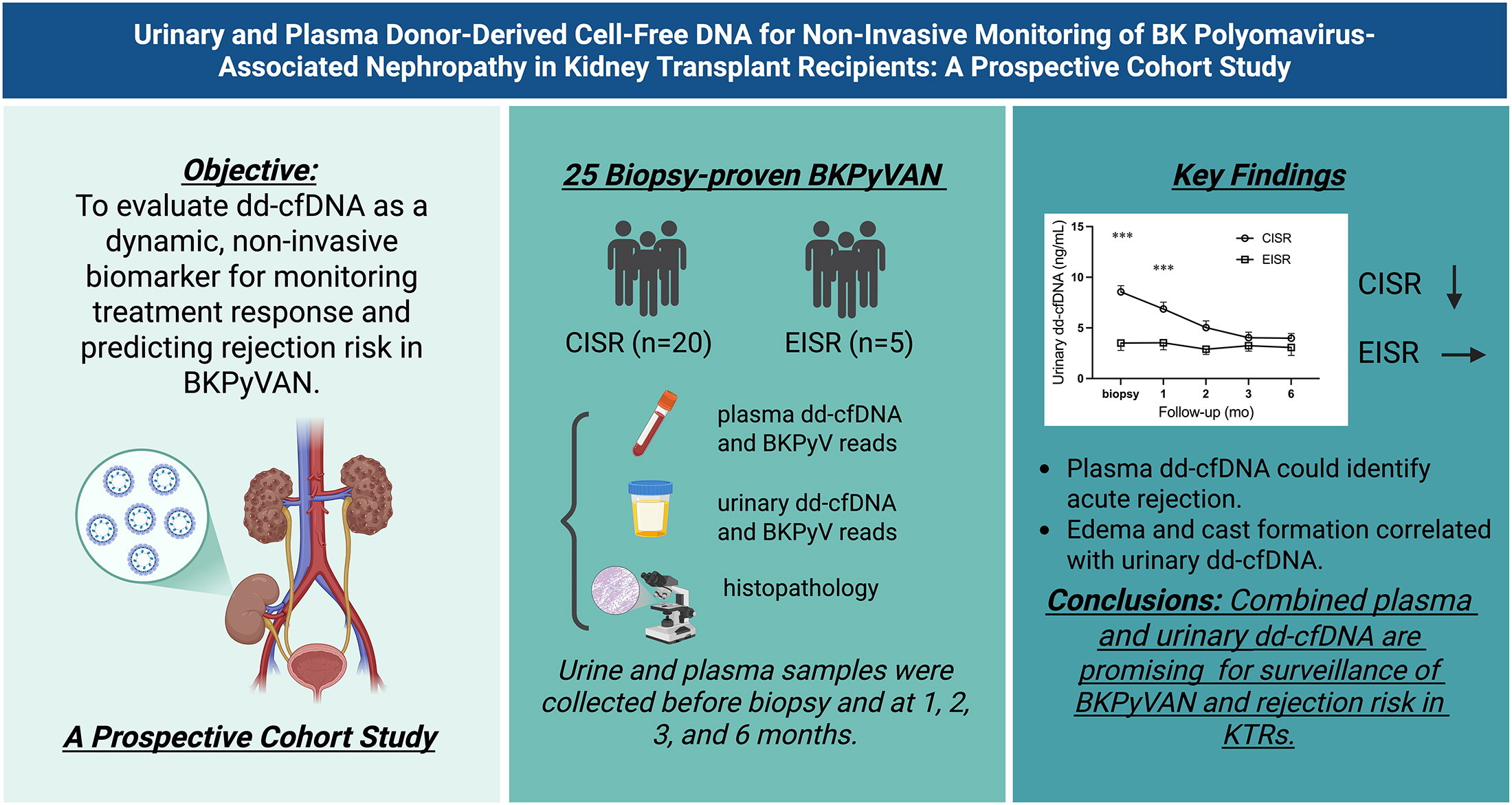
This study included 25 patients with biopsy-proven BKVAN and divided them into a traditional immunosuppressant reduction group (CISR group, n=20) and an early pre-biopsy immunosuppressive reduction group (EISR group, n=5) according to the timing of immunosuppressive adjustment. The CISR group began to adjust the immunosuppressive regimen after BKVAN was diagnosed or highly suspected, while the EISR group began to receive reduced immunosuppressant treatment before biopsy diagnosis.
At the beginning of treatment, the urinary dd-cfDNA level in the CISR group was higher and gradually decreased as treatment progressed. During the treatment process, plasma dd-cfDNA effectively identified acute rejection in 2 patients in the CISR group; in the EISR group, due to early intervention, the dd-cfDNA level was in a low and relatively stable state. Compared with the CISR group, patients in the EISR group had significantly lower urinary dd-cfDNA levels at biopsy (3.69 ng/mL), and both their urine and plasma dd-cfDNA levels remained relatively stable during the subsequent 6-month follow-up period. This result suggests that reducing immunosuppressants early may be more conducive to quickly controlling BKVAN and reducing damage to the graft. In addition, what is interesting is that in a patient whose plasma dd-cfDNA increased during the medication preparation process, critical changes were confirmed by puncture, but SV40 staining continued to be positive, suggesting that there may be a certain lag in the changes in SV protein expression during the recovery process from BKV injury.
Summary and Outlook: Dynamic monitoring guides precise treatment
Research shows that the dd-cfDNA levels of patients in the CISR group and the EISR group show different dynamic change patterns, which not only reflects differences in treatment strategies, but also highlights the potential value of dd-cfDNA in guiding clinical decision-making. As a non-invasive tool, monitoring the dynamic changes of dd-cfDNA is expected to help clinicians evaluate the treatment response of BKVAN patients in real time, provide objective basis for individualized adjustment of immunosuppression programs, and improve patients' long-term survival rate and quality of life.
Some original figures, videos and downloadable materials are provided in Chinese.