
AlloDx makes new progress in non-invasive research on bladder cancer based on urine cfDNA copy number variation analysis
Bladder cancer is one of the common malignant tumors worldwide. Currently, its clinical diagnosis mainly relies on invasive methods such as cystoscopy. Although it has diagnostic value, it has limitations such as patient discomfort, risk of infection, and difficulty in frequent monitoring. In recent years, the development of liquid biopsy technology has provided a new direction for non-invasive detection of tumors. Among them, cell-free DNA (cfDN) in urine

Bladder cancer is one of the common malignant tumors worldwide. Currently, its clinical diagnosis mainly relies on invasive methods such as cystoscopy. Although it has diagnostic value, it has limitations such as patient discomfort, risk of infection, and difficulty in frequent monitoring. In recent years, the development of liquid biopsy technology has provided a new direction for non-invasive detection of tumors. Among them, cell-free DNA (cfDNA) in urine has become an ideal biological sample for bladder cancer detection because it is directly derived from the urinary system.
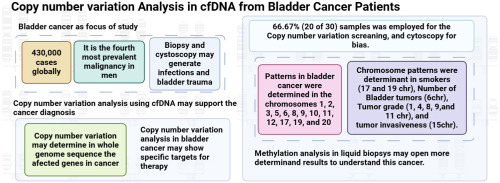
Recently, AlloDx collaborated with the School of Life Sciences of Jiangsu University, Xuzhou Cancer Hospital Affiliated to Jiangsu University, Danyang Hospital of Traditional Chinese Medicine, and Jiangsu University School of Medicine to complete a study on urinary cfDNA copy number variation (CNV) in bladder cancer. This study included urine samples from 20 patients with bladder cancer diagnosed through cystoscopy, and used next-generation sequencing (NGS) technology combined with whole-genome sequencing methods to systematically analyze the CNV patterns of their cfDNA. Statistical analysis was performed by Wilcoxon test and chi-square test (*p* ≤ 0.005), and the study identified significant CNV patterns on chromosomes 1, 2, 3, 5, 6, 8, 9, 10, 11, 12, 17, 19, and 20.
Studies have found that CNV changes in these specific chromosomal regions are closely related to patients' clinical characteristics, including smoking history, tumor number, tumor grade and invasiveness, and other parameters all show distinguishable mutation patterns. It is worth noting that multiple gene regions where CNV occurs have been reported in the literature to be associated with the occurrence and development of bladder cancer and other malignant tumors, suggesting that these genetic changes have potential biological and clinical significance.
This study shows that NGS-based urine cfDNA CNV analysis can effectively reflect the molecular characteristics of bladder cancer and provide valuable information about the disease status. This non-invasive method is expected to provide new technical paths for early screening, risk stratification and treatment strategy research of bladder cancer.
AlloDx will continue to deepen relevant research, promote the clinical transformation of technology, and is committed to providing scientific and reliable detection support for the precise diagnosis and treatment of bladder cancer.
Some original figures, videos and downloadable materials are provided in Chinese.