
AlloDx Presents Two Innovative Studies at ASN 2025
Recently, ASN Kidney Week 2025, the most influential academic event in the world of nephrology, concluded successfully in Houston, USA. As a vane that leads global kidney disease research and clinical practice, this conference brings together world-renowned experts and scholars and cutting-edge scientific and technological achievements. Following Methylation and SRNS Related Research in 2024
ASN renal periphery,AlloDx scientific research results unveiled at international events
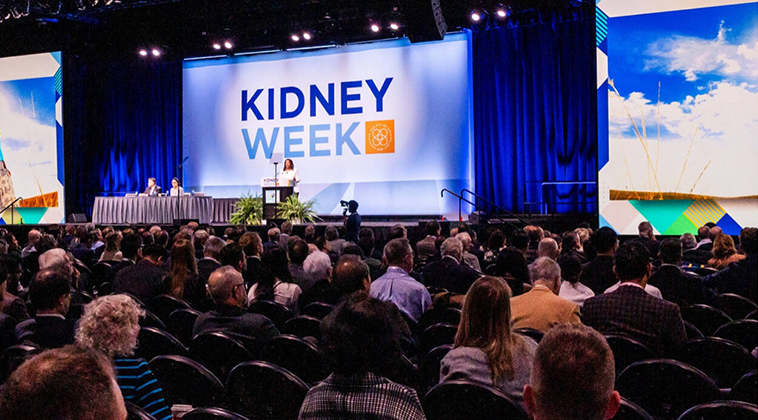
Recently, ASN Kidney Week 2025, the most influential academic event in the world of nephrology, concluded successfully in Houston, USA. As a vane that leads global kidney disease research and clinical practice, this conference brings together world-renowned experts and scholars and cutting-edge scientific and technological achievements. Following the research results related to methylation and SRNS in 2024, AlloDx once again shines on this international academic stage with two cutting-edge research results.
Study 1:Breakthrough detection technology SuperNAT achieves high levels of Nephrin antibodiessensitiveDetection
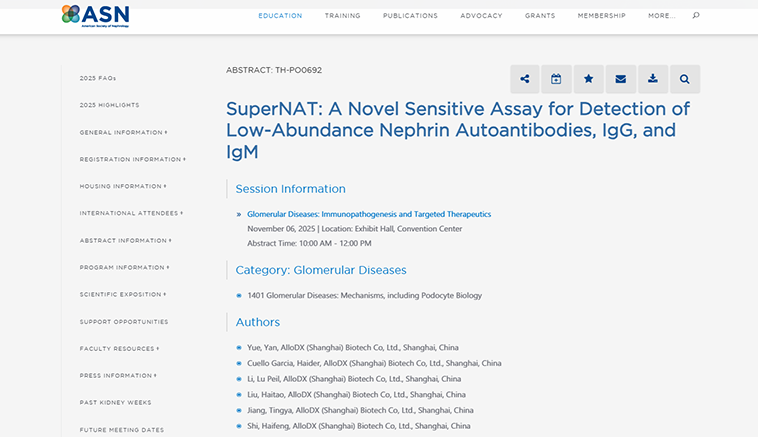
To address the diagnostic difficulties of podocyte-related diseases such as minimal change disease (MCD) and post-transplant focal segmental glomerulosclerosis (FSGS), the AlloDx R&D team successfully developed the Super Nephrin Antibody Trap (SuperNAT) detection technology. This method uses the dual innovative design of magnetic bead antigen capture and background subtraction to effectively overcome the interference of high-abundance proteins in serum and significantly improve the detection sensitivity of extremely low-abundance Nephrin autoantibodies.
Clinical verification showed that in 40 patient samples, the antibody level detected by the SuperNAT method was significantly higher than that of the healthy control group (59.71 vs. 9.22 U/mL, p < 0.0001); when 45 U/mL was used as the threshold, the positive detection rate reached 55%, which was 48.6% more sensitive than the traditional ELISA method. The study also identified two potential immune epitopes of Nephrin protein (15 aa–29 aa and 778 aa–793 aa) for the first time, providing a new direction for the study of disease mechanisms. This technology has excellent anti-interference ability, sample stability (quantitative difference within 1 month ≤7%) and automation compatibility, laying a solid foundation for large-scale clinical screening and application.
Study 2: AI-driven gene therapy significantly improves renal function in Alport syndrome model
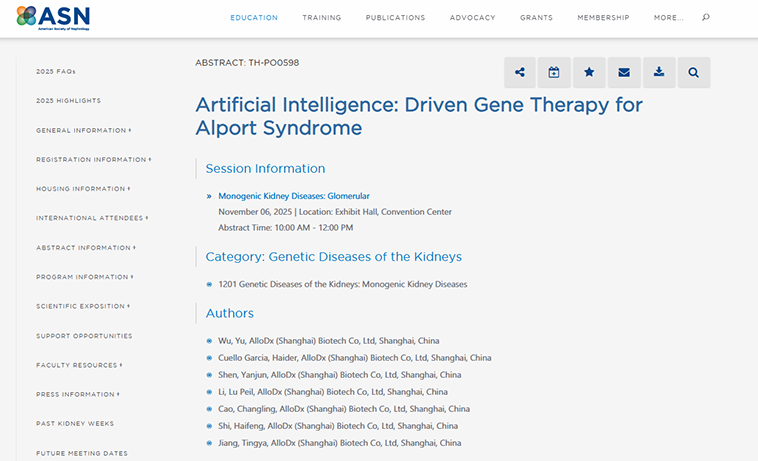
In the field of treatment, the AlloDx R&D team used deep learning algorithms to successfully design a mini-collagen α5 chain sequence that can restore the functional type IV collagen trimer structure, and delivered it to the X-linked Alport syndrome (XLAS) mouse model via an adeno-associated virus (AAV) vector. After only one month, the treatment group showed overall improvement in renal function:
Urinary albumin decreased by 79% (p = 0.0015)
Blood urea nitrogen decreased by 59% (p < 0.0001)
Serum creatinine decreased by 73% (p < 0.0001)
Immunofluorescence analysis further confirmed that the expression of α5 chain in glomerular and renal tubule basement membranes was successfully restored after treatment, and the type IV collagen network structure tended to normal, which verified the direct repair ability of this strategy for core pathological defects at the molecular level.
Some original figures, videos and downloadable materials are provided in Chinese.