
Understanding In Vivo Changes After Allogeneic CAR-T Infusion
AlloDx IndelTrace 2.0
Next-generation donor-derived DNA quantification and tracing platform
How to observe the expansion, contraction and persistence of allogeneic CAR-T cells after infusion? In addition to measuring cell numbers and CAR transgene levels in peripheral blood, DNA release signals associated with cell damage and death provide a complementary perspective for understanding in vivo changes in treated cells.
AlloDx launches IndelTrace 2.0, which uses the genetic differences between donors and recipients to identify donor-derived DNA and provides molecular-level information for in vivo dynamic studies of allogeneic cell therapy through continuous detection of plasma donor-derived cell-free DNA (dd-cfDNA).
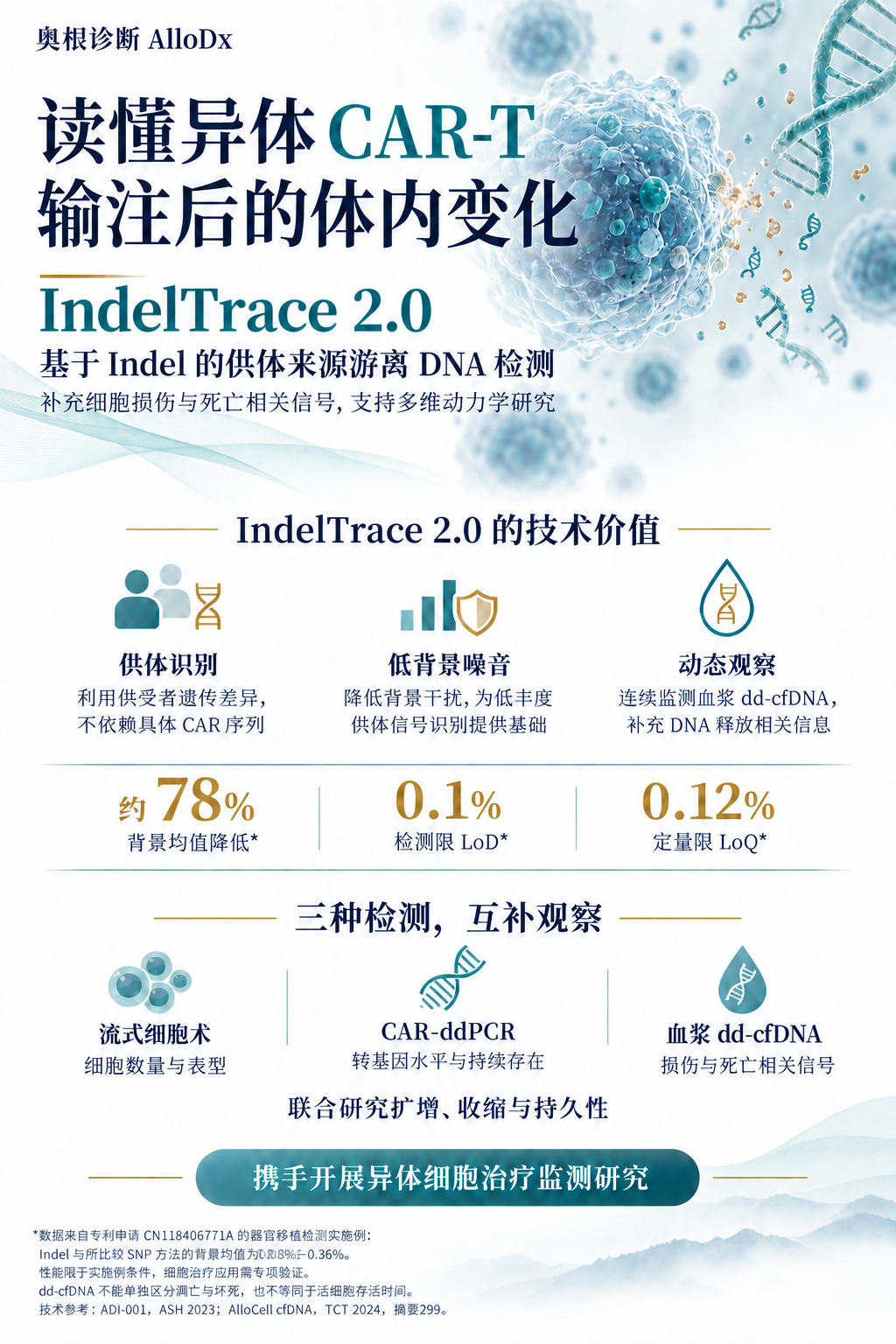
Assay Improvements for Detecting Low-abundance Donor Signals
Inheriting the technology accumulation of AlloDx's first-generation probe hybridization capture dd-cfDNA quantitative platform, IndelTrace 2.0 uses multiplex PCR targeted amplification and insertion and deletion polymorphism (Indel) markers to carry out the identification, quantification and dynamic monitoring of donor-derived DNA.
Identification based on genetic differences between donors and recipients eliminates the need to use specific CAR sequences as detection targets, providing a technical path for monitoring research on different allogeneic cell products. The specific application still needs to be verified based on the genotype of the donor and recipient, product composition and sample conditions.
Reduce Background Interference to Observe Low-level Signals
In detection of low-abundance donor DNA, reducing background interference can help distinguish true signal from detection noise. The organ transplant detection examples disclosed in the AlloDx patent application "Organ Transplant Rejection Risk Detection Method and Molecular Markers for Detection" show: [1]
The background mean was 0.08% for the Indel method and 0.36% for the compared SNP method, a reduction in background mean of approximately 78%.
The limit of detection (LoD) was 0.1% and the limit of quantitation (LoQ) was 0.12%.
These data provide a methodological basis for the identification of low-abundance donor DNA. Combining continuous sampling with a pre-infusion baseline facilitates observation of changes in the donor-derived DNA signal over time, providing information for studying the DNA release process following cell infusion.
The above indicators come from the organ transplantation examples in the patent disclosures. They are limited by their samples, input volumes, and experimental conditions. They do not directly represent the verified performance of IndelTrace 2.0 in the allogeneic CAR-T scenario; the background reduction ratio is not equivalent to the detection sensitivity improvement ratio.
Three Complementary Measurements
Allogeneic CAR-T studies have used flow cytometry, CAR-ddPCR, and donor genetic marker detection for multidimensional monitoring. [2] Analytical performance studies have also been conducted on detection methods for plasma donor-derived cfDNA. [3] Different methods focus on different objects, and their combined use can help explain more completely the dynamics in the body.
| Detection method | Detection object | Main information provided |
|---|---|---|
| flow cytometry | Live-gated CAR-positive cells | Cell number and phenotype; results are affected by detection panel, sample processing and sampling site. |
| Cellular components CAR-ddPCR | CAR transgenic DNA | Transgene level and persistence; cannot alone prove cell survival or function. |
| IndelTrace 2.0 Plasma dd-cfDNA Test | Donor-derived cell-free DNA | Supplement DNA release information related to cell damage and death; explanation needs to be combined with release, clearance and background changes. |
dd-cfDNA cannot distinguish between apoptosis and necrosis alone, nor can it be directly converted into cell death rate or viable cell survival time. Donor-derived DNA is also not equivalent to CAR-positive cell-derived DNA; additional evaluation of signal attribution is required when other cells from the same donor or in a multi-donor background are present. The detection ratios, denominators and input amounts of the three methods are different, so it is not appropriate to directly compare sensitivities based on percentages.
Collaborate on Monitoring Research for Allogeneic Cell Therapies
AlloDx looks forward to cooperating with cell therapy companies, clinical research teams and scientific research institutions to combine IndelTrace 2.0 with flow cytometry, CAR-ddPCR and other methods to establish a continuous observation program around amplification, shrinkage and persistence, and explore the relationship between donor-derived DNA signals and changes in cells in vivo.
AlloDx IndelTrace 2.0 | Identify trace donor signals and study dynamic changes in the body.
References
[1] Suzhou AlloDx Technology Co., Ltd. Organ transplant rejection risk detection methods and molecular markers for detection. Patent application publication CN118406771A, 2024-07-30. https://patents.google.com/patent/CN118406771A/en
[2] Moreno et al. Expansion, Persistence and Pharmacodynamic Profile of ADI-001, a First-in-Class Allogeneic CD20-targeted CAR Gamma Delta T Cell Therapy, in Patients with Relapsed/Refractory Aggressive B-cell Non-Hodgkin’s Lymphoma. ASH 2023. The donor genetic marker in this study was detected as cellular component DNA, not plasma dd-cfDNA. https://www.adicetbio.com/file.cfm/42/docs/3478.pdf
[3] Wong L et al. AlloCell cfDNA Assay Performance Validation Meeting Summary. Transplantation and Cellular Therapy. 2024;30(Suppl):S229, Abstract 299. DOI: 10.1016/j.jtct.2023.12.299.