
Scientific research results | Clinica Chimica Acta published an article: A new non-invasive BK virus-related nephropathy detection technology
Recently, AlloDx (AlloDx Biotech), together with Jiangsu University, Tongji Hospital Affiliated to the School of Medicine of Huazhong University of Science and Technology and other institutions, published a study on BK virus-related nephropathy (B
Recently, AlloDx (AlloDx Biotech), together with Jiangsu University, Tongji Hospital Affiliated to the School of Medicine of Huazhong University of Science and Technology and other institutions, published an important research result on the detection of BK virus-associated nephropathy (BKPyVAN) "Diagnostic value of three urine miRNAs composite score in BK virus nephropathy" in Clinica Chimica Acta (CCA), the official magazine of the International Association for Clinical Chemistry and Laboratory Medicine (IFCC). This research result is based on urine miRNA detection technology and successfully developed the world's first "PymiR Score" scoring system, which is a new, non-invasive BKPyVAN detection platform.

Article link: https://doi.org/10.1016/j.cca.2025.120162
Currently, clinical assessment of the degree of BKV infection is mainly based on hematuria BK virus copy number (BKV-DNA) and renal biopsy SV40 immunohistochemistry. However, the former only assesses the load/load of BKV in the body and does not reflect its metabolic activity and damage to the kidneys. Therefore, it is difficult to use a unified DNA copy number to guide clinical treatment; kidney biopsy cannot be used as a routine clinical detection method. In addition, SV40 staining indicates the expression of BKV-related proteins. It is the result of BKV using its DNA genetic information to finally form a protein with specific functions; other detection technologies, such as Decoy cells and ddcfDNA detection, reflect the degree of kidney damage caused by BKV. When the detection value increases, it indicates that BKV has caused kidney damage.
So, is there a marker that is between the BKV-DNA copy number and the kidney injury process and can non-invasively diagnose the degree of BKV infection?
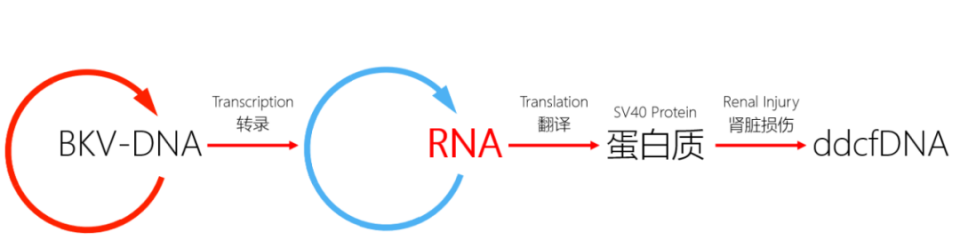
Figure1. Biological processes of BK virus in the kidney:According to the central dogma of biology,RNA is transcribed from BKV-DNA and translated into protein. RNAable to reflectBKV transcriptional activity。
The AlloDx R&D team took a new approach and focused on three key biomarkers in urine - BK virus-specific miRNA (bkv-miR-B1-5p, bkv-miR-B1-3p) and kidney injury marker miRNA (miR-21-5p). At the RNA expression level (Figure 1), they integrated the three expression levels through an innovative algorithm to build a "PymiR Score" scoring model.
High stability and repeatability:Quantitative range 5.7*105-5.7*1010copies/μL, minimum detection limit 2*103copies/mL, the coefficients of variation of Ct values within and between groups were 2.13%-3.59% and 2.30%-3.35%, respectively. (Figure 2)
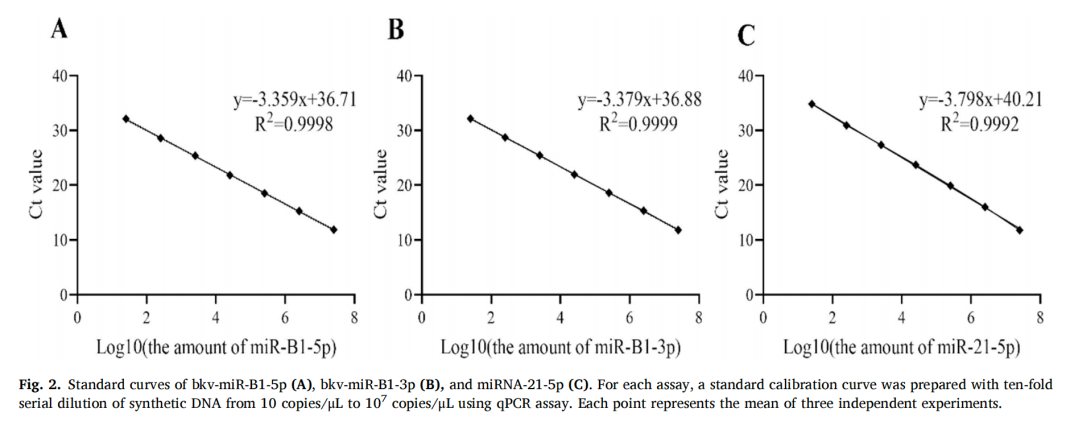
Figure2
Strong detection specificity:Unaffected by other infections such as JC polyomavirus (JCV), parvovirus (B19), cytomegalovirus (CMV) and Epstein-Barr virus. (Figure 3)
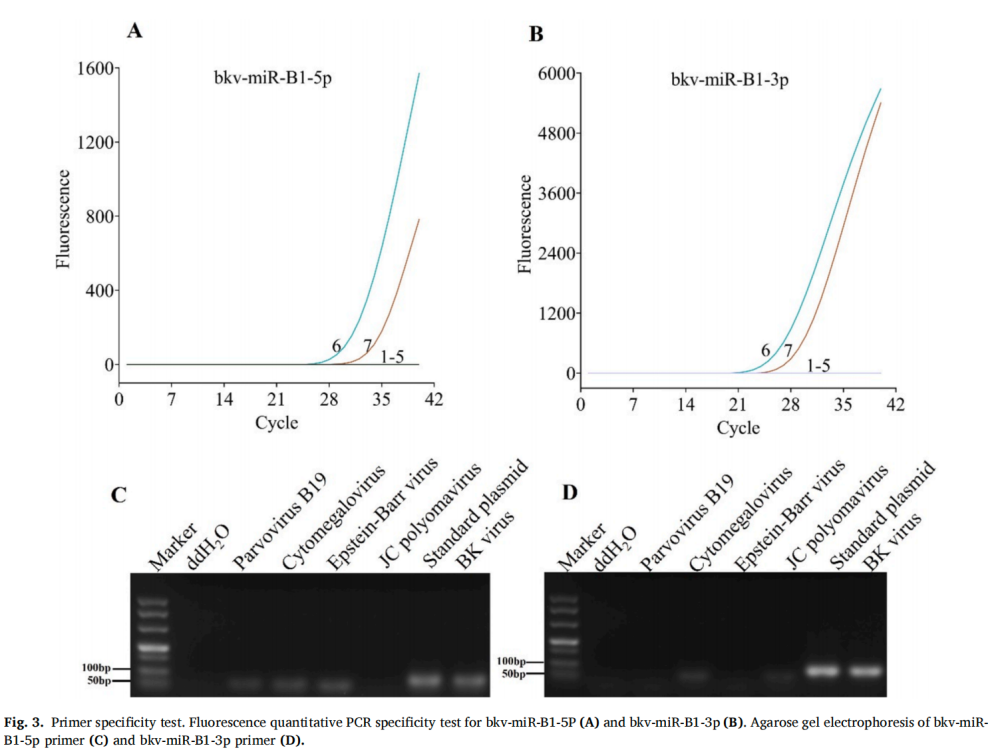
Figure3
PymiR Score scoring model:The maximum value is reached when the critical value ≥71.78, confirming the discriminative ability of the model in the validation set. (Figure 4)

Figure4:Ct1, Ct2 and Ct3 are the Ct values of bkv-miR-B1-5p, bkv-miR-B1-3p and miR-21-5p respectively in qPCR.
Accuracy jumps:Clinical verification shows that the area under the curve (AUC) of PymiR Score in distinguishing BK virus infection and kidney disease reaches 0.87, with a sensitivity of 76.9% and a specificity of 100%, which is significantly better than traditional plasma viral DNA detection (AUC=0.73). (Figure 5)
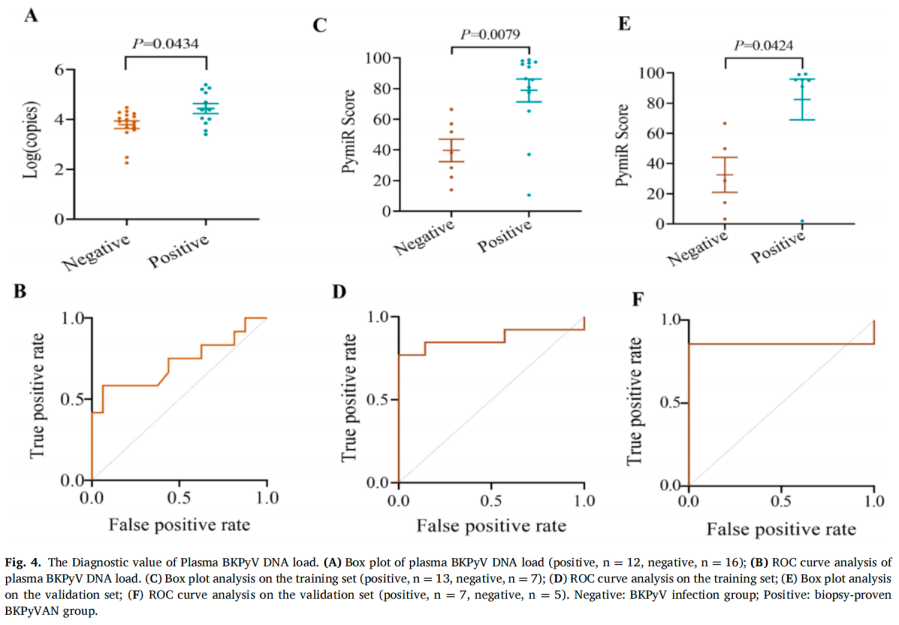
Figure5
This study by the AlloDx R&D team is the first in the world to simultaneously detect the levels of multiple miRNAs in the urine of kidney transplant recipients and establish the BKPyVAN risk model, the PymiR Score comprehensive risk score model. At the same time, the accuracy of the model in identifying patients with BKV infection and BKPyVAN was preliminarily verified. The research results were also invited to be presented at the American Organ Transplantation Conference (ATC2024) in June 2024. Its further clinical significance requires more clinical research designs to explore and verify.
Conclusion
AlloDx takes "technology to protect life" as its mission, and this research result demonstrates the company's innovative capabilities in the field of international organ transplant testing. In the future, with the widespread application of PymiR Score, countless kidney transplant patients will benefit from this new "non-invasive, accurate and efficient" testing solution.
Some original figures, videos and downloadable materials are provided in Chinese.