
Research in the Journal of Zhejiang University Identifies a Biomarker to Distinguish BKVAN from TCMR
With the use of highly effective immunosuppressants, infection after kidney transplantation is one of the main problems faced by patients, especially BK virus-related nephropathy, which is one of the common causes of graft failure. The gold standard for the diagnosis of BK virus-related nephropathy is transplanted kidney biopsy, and its pathological manifestations are tubulitis and interstitial inflammation, which are similar to TCMR. SV40 false negative rate on biopsy
With the use of highly effective immunosuppressants, infection after kidney transplantation is one of the main problems faced by patients, especially BK virus-related nephropathy, which is one of the common causes of graft failure. The gold standard for the diagnosis of BK virus-related nephropathy is transplanted kidney biopsy, and its pathological manifestations are tubulitis and interstitial inflammation, which are similar to TCMR. The false negative rate of SV40 during biopsy is high, and it is difficult to distinguish BK virus-related nephropathy and TCMR clinically based on pathology. Because the two treatment directions are completely opposite, it brings confusion to clinical diagnosis and treatment decisions.
Recently, the important research results of Wang Rending's team at the Kidney Disease Center of the First Affiliated Hospital of Zhejiang University, in collaboration with the AlloDx Medical Department, were published online in "Journal of Zhejiang University English Version B: Biomedicine and Biotechnology" (Biomedicine Zone 2, IF=3.066). This study discovered for the first time a new biomarker that can be used to distinguish BK virus-related nephropathy and TCMR.
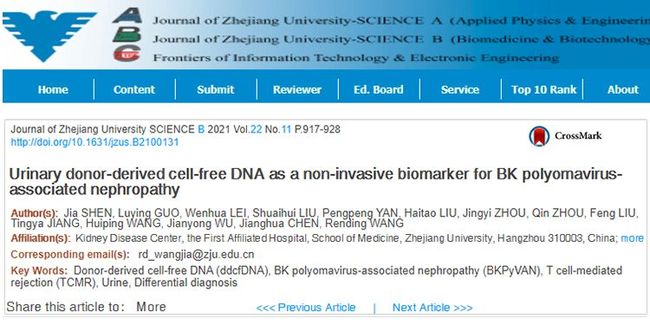
Wang Rending's team used target region capture sequencing method to detect the ddcfDNA of 12 patients with stable renal function, 22 patients with type I TCMR, 21 patients with pathological diagnosis of BK virus-related nephropathy, and 5 patients with suspected polyoma virus-related nephropathy. They found that when the graft was damaged, the ddcfDNA level in the patient's urine increased, but there was no significant change in ddcfDNA in the plasma. The median concentration and percentage of urinary ddcfDNA in the pathologically confirmed BK virus-related nephropathy group were significantly higher than those in the grade I TCMR group (10.4 vs. 6.1 ng/mL, P<0.001; 68.4% vs. 55.3%, P=0.013). In the pure BK virus-related nephropathy subgroup, the percentage of urinary ddcfDNA was significantly higher than that in the BKPyVAN rejection-like change group (81.30% vs. 56.64%, P=0.025), while the concentration of ddcfDNA was not significantly increased. The urine ddcfDNA concentration of 7.81 ng/mL can be used as the threshold to distinguish pathologically confirmed BKPyVAN from grade I TCMR (AUC=0.848, 95% confidence interval: 0.734-0.963).
This study shows that urinary ddcfDNA, as a non-invasive biomarker, can help distinguish BK virus-related nephropathy from TCMR, and can be an effective supplement to needle biopsy, which is expected to provide an important basis for clinical diagnosis and treatment.
——
Original link:
Some original figures, videos and downloadable materials are provided in Chinese.