
ddcfDNA is a biomarker for accurate diagnosis of kidney transplant antibody-mediated rejection (ABMR)
Recently, the Kidney Disease Center of the Eastern Theater Command General Hospital cooperated with the AlloDx Medical Department to use AlloDx AlloK seqTM [Ankang] non-invasive detection platform for kidney transplantation, conducted a retrospective study on 50 patients with suspected rejection. Revealed the diagnostic antibody-mediated role of donor-derived cell-free DNA (ddcfDNA) in Chinese kidney transplant patients
Recently, the Kidney Disease Center of the Eastern Theater Command General Hospital cooperated with the AlloDx Medical Department to use AlloDx AlloK seqTM [Ankang] non-invasive detection platform for kidney transplantation, conducted a retrospective study on 50 patients with suspected rejection. Revealed the value of donor-derived cell-free DNA (ddcfDNA) in diagnosing antibody-mediated rejection in Chinese kidney transplant patients. Relevant results were published in Transplant, an authoritative international magazine in the field of organ transplantation. Immunology".
In this retrospective observational study, 50 kidney transplant recipients diagnosed with suspected rejection at the Eastern Theater Command General Hospital from June 2018 to May 2019 were included. AlloK The seqTM targeted capture sequencing method detects the concentration of ddcfDNA in plasma. According to the results of pathological biopsy (ABMR or not) and donor-specific antibodies (DSA), patients are clinically divided into four groups: ABMR+/DSA+, ABMR+/DSA-, ABMR-/DSA and ABMR-/DSA-. The results show that the median ddcfDNA concentration in the ABMR+ group (1.66%, IQR 1.34-3.76%) was significantly higher than the ABMR- group (0.63%, IQR 0.43-0.74%; p< 0.001). Receiver operating characteristic curve (ROC) analysis with its area under the curve (AUC) is 0.90 (95%CI, 0.86–0.95). When the ddcfDNA threshold is set to 0.96%, the detection sensitivity is 90.5% (95%CI, 69.6–98.8%) and the specificity is 96.6% (95% CI, 82.2–100%), PPV 95% (95% CI, 73.4–99.2%), and NPV 93.3% (95% CI, 78.9–98.1%). The accuracy is much higher than DSA in diagnosing ABMR (specificity 50%, sensitivity 74.1%, PPV 41.7%, NPV 80%). There was no significant difference in ddcfDNA between DSA+ group and DSA- group (p>0.05). Research shows that no matter DSA is positive or negative, as long as ddcfDNA is elevated, ABMR may occur in all cases, and ddcfDNA can be used to independently and accurately diagnose the occurrence of ABMR.
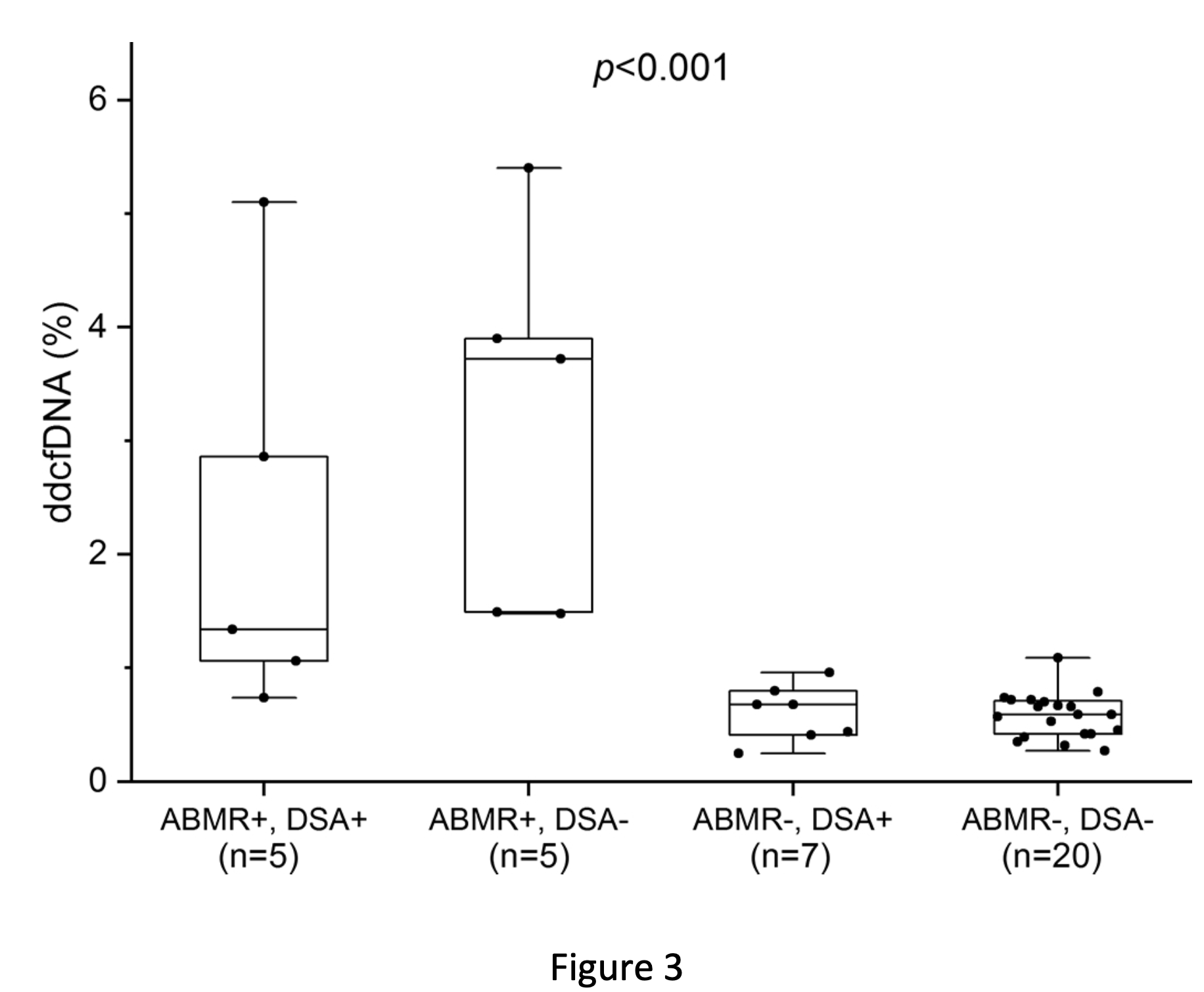
ddcfDNA is a new type of non-invasive diagnostic biomarker for organ transplantation, which is comparable to traditional markers in kidney transplantation. (serum creatinine, antibodies, etc.), has higher specificity and sensitivity. Since its clinical application in 2018, it has been routinely performed in kidney transplant centers abroad. The cumulative number of patients tested exceeds 150,000. In this study, the value of AlloK seqTM in antibody-mediated rejection was evaluated for the first time in the Chinese population. It provides an accurate and non-invasive method for the diagnosis of rejection in Chinese kidney transplant patients.
Some original figures, videos and downloadable materials are provided in Chinese.