
Biomarker Insights: Why Is C3NeF Difficult to Measure Accurately?
C3NeF is one of the functional drivers of abnormal activation of the alternative complement pathway. The key to measuring it accurately lies in whether the functional status of the invertase can be reliably read, rather than just a "yes or no" judgment. In a context where methods have not yet been standardized and there are many interference factors, understanding the above-mentioned links is the prerequisite for interpreting the C3NeF report.
Marker Insights | Why C3NeF is Difficult to Measure Accurately
——
C3 nephritic factor (C3NeF) has been repeatedly mentioned in complement-mediated kidney diseases, but its detection logic is often simplified. Clinically, it is easy to regard it as an ordinary antibody and make a "yes or no" judgment; but what it really needs to reflect is the functional stabilizing effect of autoantibodies on complement converting enzyme. The presence of antibodies in the blood does not mean that they have the ability to drive disease. This article explains it from three aspects: mechanism, clinical value and detection method.
The complement system has three activation pathways: classical, lectin and alternative, which ultimately converge on the same amplification link - C3 convertase: the classical and lectin pathways form C4b2a, and the alternative pathway forms C3bBb. Both further assemble C5 convertase, initiating the formation of the membrane attack complex (MAC). C3NeF targets none other than the C3 convertase C3bBb of the alternative pathway. It is mainly IgG, and the antibodies produced by different patients have obvious differences in the site of action and intensity. It is a type of autoantibodies with strong heterogeneity [2,3].
The role of C3NeF
Normally, C3bBb has a short lifespan. Factor D cleaves Factor B to generate Bb and remains on C3b. Then regulatory proteins such as complement factor H (CFH), CR1 and decay-accelerating factor (DAF) promote the dissociation of the complex. Its half-life is usually only a few seconds to tens of seconds.
This process is altered after C3NeF binds to C3bBb [3,5]. C3NeF spans the complex interface of C3b and Bb, making invertase less susceptible to decay and blocking the binding of CFH, CR1, DAF and C3bBb. As a result, the half-life of C3 convertase is extended from seconds to tens of minutes or even hours, C3 and C5 convertase are continuously produced, and C3b is continuously deposited in the glomerular capillary loops.
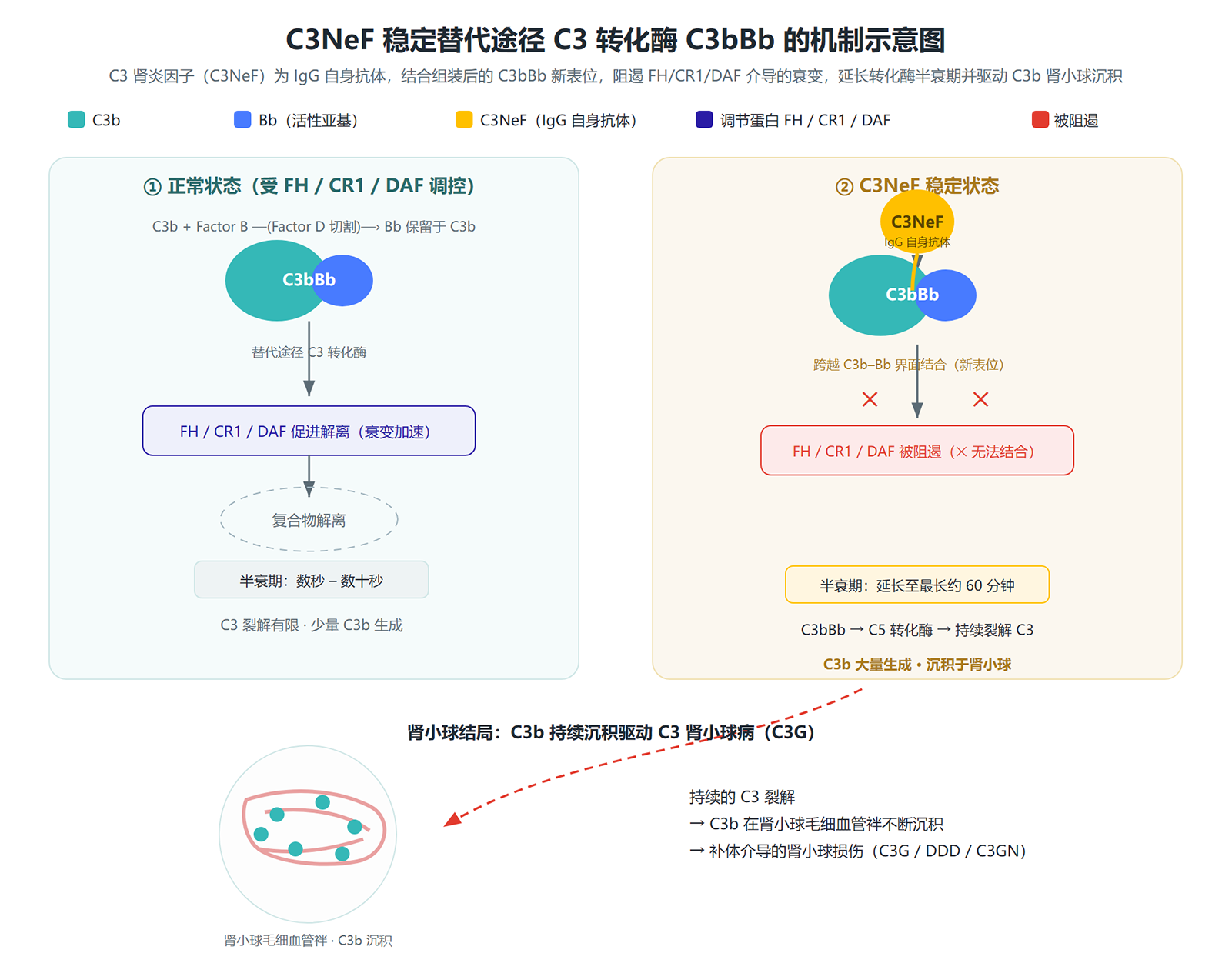
Figure | C3NeF stabilizes C3bBb and drives C3b glomerular deposition
It is worth noting that the ability of different C3NeFs to extend the half-life of invertase is not consistent; depending on whether it depends on properdin (properdin), it can also be divided into properdin-dependent and independent types. Therefore, "detecting antibodies" and "detecting antibodies with strong driving effects" are not the same thing.
Why clinical attention is paid to C3NeF
C3 glomerulopathy (C3G) is a group of rare kidney diseases characterized by predominant glomerular C3 deposition and little or absent immunoglobulin deposition. It is divided into two subtypes: dense deposit disease (DDD) and C3 glomerulonephritis (C3GN) [1,6]. C3NeF is a major causative driver in many patients with C3G: in a cohort of 32 patients with DDD, C3NeF was detected in 78% (25 patients) [4]. In addition to C3G, C3NeF is also associated with immune complex-mediated membranoproliferative glomerulonephritis (IC-MPGN), systemic lupus erythematosus, acquired partial lipodystrophy, and some infections [2,3]. HypoC3emia is a common laboratory manifestation in patients with positive C3NeF [2]. Since only about 50%–70% of patients with C3G have reduced C3 levels, normal C3 does not exclude disease [7] – which is why specific tests such as C3NeF are still needed when C3 is normal.
Existing detection methods and their limitations
Existing C3NeF assays are roughly divided into two categories: functional experiments and binding experiments. Functional experiments (such as hemolysis readings, convertase activity readings) read the downstream effects of the complement pathway, which are closer to the amplification degree of the overall pathway, but the final readings are affected by multiple complement components at the same time: enhanced hemolysis can only indirectly suggest that there may be more C3bBb stabilized, and it is difficult to attribute it to C3NeF alone. Binding experiments (such as indirect ELISA) detect whether the antibody binds to C3bBb, which is more specific, but is susceptible to interference from non-specific binding and the patient's own anti-Factor B (anti-FB) antibodies - this type of method usually uses anti-human IgG secondary antibodies to read the signal, and anti-FB antibodies will also be read.
In addition, the two types of methods also have common problems: nephritic factor detection has not been standardized, the operation is complex, and there is a lack of appropriate quality control [2,3]. There are many platforms that can detect signals, but platforms that can reflect the impact of C3NeF on invertase function in a stable, quantifiable, and less interference-free manner are still scarce. This also shows once again that the core of C3NeF detection is not "detection", but "whether its functional significance can be explained after detection".References
1. Pickering MC, D'Agati VD, Nester CM, et al. C3 glomerulopathy: consensus report. Kidney Int. 2013;84(6):1079-1089. PMID: 24172683
2. Corvillo F, Okrój M, Nozal P, et al. Nephritic Factors: An Overview of Classification, Diagnostic Tools and Clinical Associations. Front Immunol. 2019;10:886. PMID: 31068950
3. Michels MAHM, Volokhina EB, van de Kar NCAJ, van den Heuvel LPWJ. Challenges in diagnostic testing of nephritic factors. Front Immunol. 2022;13:1036136. PMID: 36451820
4. Zhang Y, Meyer NC, Wang K, et al. Causes of alternative pathway dysregulation in dense deposit disease. Clin J Am Soc Nephrol. 2012;7(2):265-274. PMID: 22223606
5. Zhao F, Afonso S, Lindner S, et al. C3-Glomerulopathy Autoantibodies Mediate Distinct Effects on Complement C3- and C5-Convertases. Front Immunol. 2019;10:1030. PMID: 31214159
6. Expert group of the Department of Nephrology, Peking University Health Science Center. Expert consensus on the diagnosis and treatment of complement-related nephropathy. Chinese Journal of Internal Medicine. 2024;63(3):258-271. DOI: 10.3760/cma.j.cn112138-20230822-00075
7. KDIGO 2021 Clinical Practice Guideline for the Management of Glomerular Diseases. Kidney Int. 2021;100(4S):S1-S276.
This article is popular science content and does not constitute medical advice, nor does it replace the registration certificate, instructions and clinical judgment. C3NeF test results must be interpreted in conjunction with clinical manifestations, renal biopsy and comprehensive complement assessment; any test-related diagnosis and treatment decisions should be made in accordance with your doctor's advice.
Some original figures, videos and downloadable materials are provided in Chinese.