
Biomarker Insights: Which Monoclonal Antibodies Can Accurately Measure sC5b-9?
AlloDx CompliTCC™ is based on independently developed AD99 and improves selectivity for complete sC5b-9 complexes from the antibody epitope level.
Marker Insight | What kind of monoclonal antibody can accurately detect sC5b-9?
——
AlloDx believes that a monoclonal antibody that can accurately detect sC5b-9 must meet two conditions at the same time: only recognize the target structure after C9 has completed polymerization, and at the same time remain silent against large amounts of monomeric C9 and other free terminal complement components in the blood. Focusing on this standard, the AlloDx R&D team spent more than two years completing multiple rounds of immunization, fusion, screening, counter-screening and subcloning, and finally locked in on the self-developed AD99 monoclonal antibody.
AlloDx's antibody standard is not just "able to bind C9", but only produces a specific signal after C9 aggregates to form the final complex.

Figure 1 | AD99 screening emphasizes the two-way criteria of "aggregated C9 positive" and "free component negative".
AlloDx's answer: The target is not C9, but the aggregated nascent epitope
AD99 faces a conformational problem. When C9 exists as a monomer in plasma, the target spatial conformation has not yet been formed; when C9 is recruited to C5b-8 and co-assembled with adjacent C9 subunits, the surfaces of the two adjacent subunits are spatially close, creating a new quaternary structure epitope. Public studies have proven that poly-C9-related neoepitopes can be composed of adjacent C9 and can be recognized by conformation-specific monoclonal antibodies. Based on in-house functional screening and structural modeling, AD99 was used to identify this aggregation state rather than treating all C9-containing molecules as positive. The precise atomic contact sites should still be subject to formal epitope analysis.
From positive wells to monoclonals: Eliminating interference at every turn
AlloDx's hybridoma screening begins with polymeric C9 immunization. After the B cells generated from the immunized animals were fused with myeloma cells, the researchers first searched for positive wells that reacted to polymerized C9 from a large number of culture wells; and then immediately performed reverse elimination: any wells with obvious signals for free components such as monomeric C9, C5b, C6, and C7 would not enter the next round even if they reacted strongly to polymerized C9. The candidate cells then go through limiting dilution subcloning, repeated culture, cryopreservation and recovery, and batch consistency verification to confirm the monoclonal source and secretion stability, and finally enter the paired screening of capture antibody and detection antibody.
ELISA evidence must demonstrate both specificity and dose dependence
Qualified ELISA evidence should answer both questions. First, specificity: at the same or challenging antigen concentration, the OD450 of monomeric C9 and components such as C5b, C6, and C7 should be close to blank, while sC5b-9 or polymerized C9 should produce clear signals. Second, dose dependence: As the concentration of sC5b-9 standard increases, OD450 should show a continuous and repeatable gradient change instead of only a single positive point.
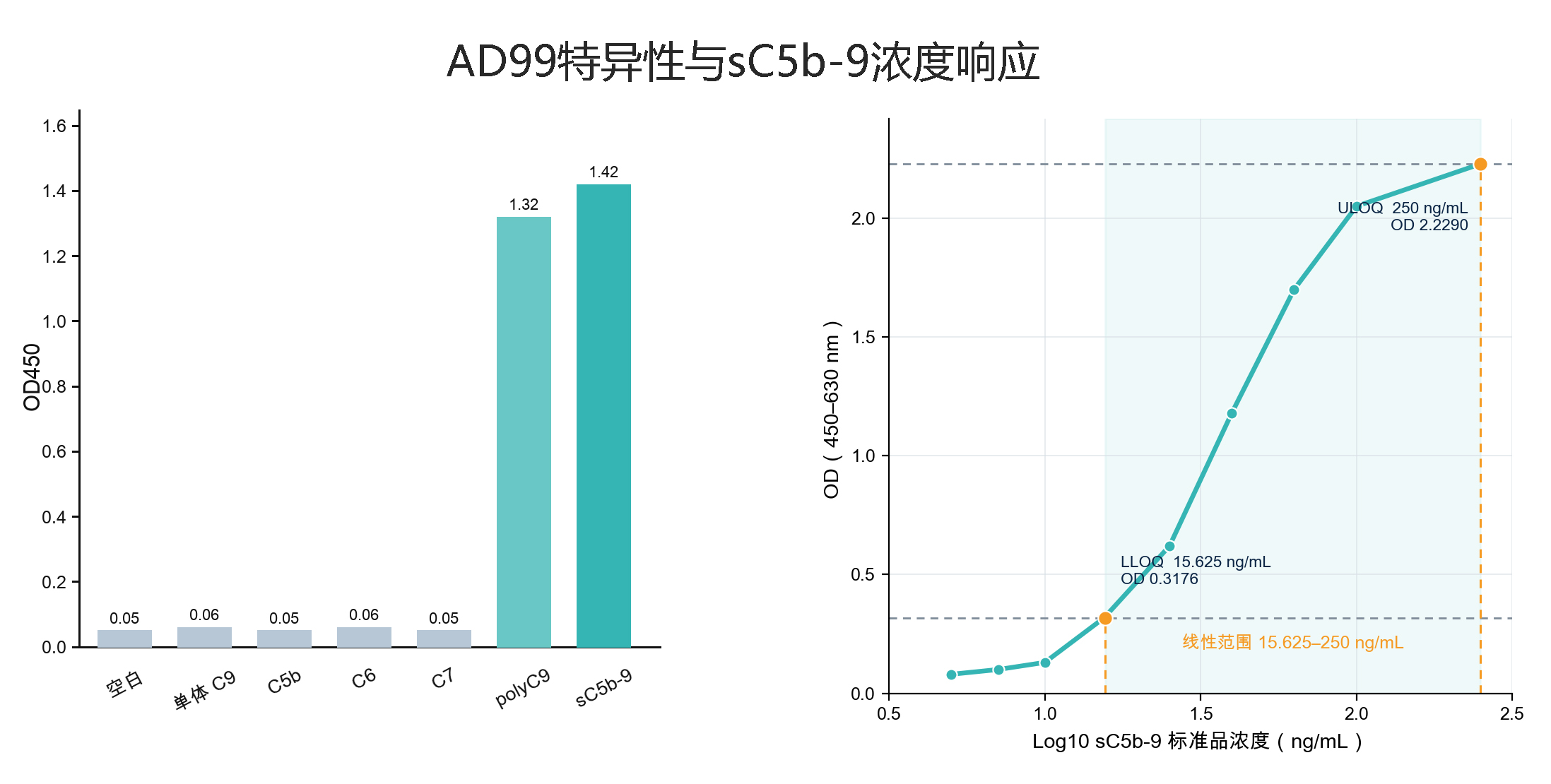
Figure 2 | The left picture shows the specific screening data; the right picture has a linear range of 15.625–250 ng/mL.
Dual structure confirmation to reduce “catching the wrong molecule”
In the double-antibody sandwich system of AlloDx CompliTCC™ sC5b-9 ELISA Kit, AD99 is responsible for "confirmation of aggregated C9 status" and another detection antibody is responsible for "confirmation of C5b domain". Monomeric C9 cannot satisfy both conditions at the same time; free C5b, C6 or C7 cannot form a complete sandwich either. Only sC5b-9 that contains C5b and presents the aggregated C9 neo-epitope will produce the final read. This dual structure confirmation is more important than simply pursuing the high affinity of a certain antibody strain, because the core of the test is not "catch more" but "catch the right one."
The development process of AD99 reflects AlloDx's basic standards for complement detection: each project must first ask which molecular state the antibody recognizes, and then verify whether it reads precursors, cleavage fragments or homologous complexes together. The independently developed AD99 and its pairing system form the core technical basis of the AlloDx CompliTCC™ sC5b-9 detection method.
AlloDx CompliTCC™ With the independently developed AD99 as the core, the selectivity for the complete sC5b-9 complex is improved from the antibody epitope level.
References
1. Hugo F, Jenne D, Bhakdi S. Monoclonal antibodies against neoantigens of the terminal C5b-9 complex. Biosci Rep. 1985;5:649-658. PMID: 2415178.
2. Kusunoki Y, Takekoshi Y, Nagasawa S. Using polymerized C9 to produce a monoclonal antibody against a neoantigen of TCC. J Pharmacobiodyn. 1990;13:454-460. PMID: 2290128.
3. The neoepitope of complement C5b-9 MAC is formed by proximity of adjacent ancillary regions of C9. 2023. PMID: 36639734.
Some original figures, videos and downloadable materials are provided in Chinese.