
From Mechanism to Monitoring: AlloDx at ASN Kidney Week 2026 Presents a New Layout for Kidney Disease Testing
ASN Kidney Week 2026 was held in Denver from 21 to 25 October 2026 by the American Society of Nephrology (ASN). Under the theme Kidney Testing Portfolio, AlloDx presented four product lines — complement testing, podocyte autoantibody testing, IgA nephropathy-related testing and kidney transplant monitoring — at the scientific exhibition, which was open from 22 to 24 October.
According to figures released by ASN, the congress attracted close to 12,000 participants from nearly 100 countries, with more than 3,000 e-posters. Across precise disease classification, marker selection and dynamic monitoring, the meeting reflected a trend of multidisciplinary convergence, in which clinical needs and testing technologies advance each other.
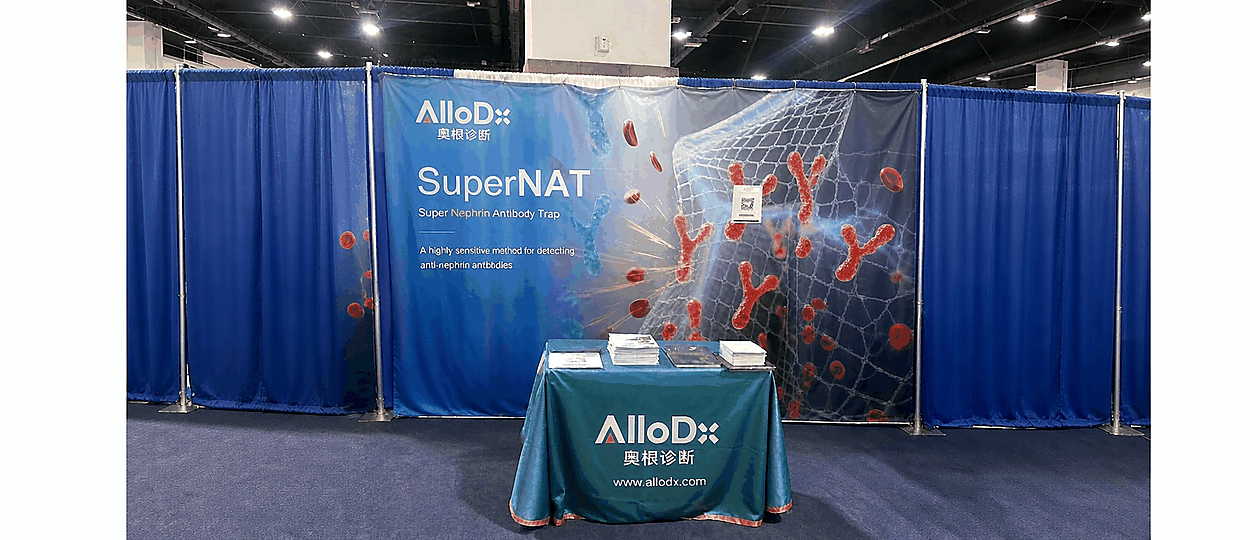
During the scientific exhibition, AlloDx held wide-ranging exchanges at Booth 991 in Hall A with professionals from clinical, research and industry backgrounds, covering testing approaches and clinical application scenarios.
The AlloDx booth was organised around the theme Kidney Testing Portfolio, presenting four product lines — complement testing, podocyte autoantibody testing, IgA nephropathy-related testing and kidney transplant monitoring — with SuperNAT anti-nephrin antibody testing as the core exhibit, outlining the company's product layout in kidney disease testing.
1. Starting from disease mechanisms: making test results relevant to clinical questions
As research into kidney disease deepens, clinical interest is no longer limited to diagnosis and classification. It also covers the specific step at which abnormalities arise, the information contributed by different markers, and how test results support subsequent assessment.
Complement-mediated glomerular disease is a representative case. This year's ASN programme included sessions dedicated to complement-mediated glomerular disease, covering complement activation pathways, regulatory mechanisms and potential intervention targets. For diseases such as C3 glomerulopathy (C3G) and thrombotic microangiopathy (TMA), understanding abnormal complement activation and the loss of its regulation helps clarify the direction of testing and clinical assessment.
Taking the alternative pathway as an example, C3 nephritic factor (C3NeF) can stabilise C3 convertase and sustain complement activation, while anti-complement factor H antibody (Anti-FH Ab) may affect the regulatory function of factor H. The soluble terminal complement complex (sC5b-9) informs on the activation state of the terminal pathway, whereas markers such as C3a, C5a and Ba reflect different steps of the complement cascade.
These markers correspond to distinct biological processes. Analysing results from different steps together moves assessment from single-marker observation towards an integrated view of abnormal complement status. The AlloDx complement panel is organised around this principle, offering multi-dimensional marker options for research and testing applications.
2. Four product lines covering different evaluation needs
The booth organised product content by disease area, so that visitors could review relevant solutions against their specific research or testing requirements.
01 Complement testing: activation and regulation status
The complement panel covers sC5b-9, C5a, C3a, Ba, complement factor H (FH), complement factor B (FB) and complement factor I (FI), as well as Anti-FH Ab, anti-complement factor B antibody (Anti-FB Ab) and C3NeF.
These markers correspond to the complement cascade, terminal pathway activation and alternative pathway regulation. They can inform mechanistic research and integrated assessment of complement-related disease. Selection of specific tests and interpretation of results still depend on disease background, clinical presentation and other laboratory findings.
02 Podocyte autoantibody testing: markers of podocyte injury
Podocytes are essential for maintaining the integrity of the glomerular filtration barrier, and antibodies directed against podocyte targets have drawn increasing attention in nephrology research.
AlloDx presented two testing panels, Podoarray-2 and Podoarray-8. Podoarray-2 covers targets including Podocin and Kirrel1; Podoarray-8 covers PLA2R, THSD7A, NELL-1, NCAM1, HTRA1, SEMA3B, CNTN1 and PCDH7.
These panels offer different target options for podocyte autoantibody research and for the differential evaluation of selected glomerular diseases. Their practical value still needs to be judged against the performance evidence of the corresponding methods and the results of clinical studies.
03 IgA nephropathy-related testing: immune abnormalities and disease mechanisms
Focusing on the mechanisms of IgA nephropathy, AlloDx presented testing directions that include galactose-deficient IgA1 (Gd-IgA1), Gd-IgA1-IgG immune complexes, and the B-cell related factors BAFF and APRIL.
These markers relate respectively to abnormally glycosylated IgA1, the formation of related immune complexes, and the regulation of B-cell activation and differentiation. Studying them together can support a multi-angle understanding of the immune abnormalities associated with IgA nephropathy, and provide reference for marker research and disease assessment.
04 Transplant monitoring: dynamic changes in graft status
Long-term management after kidney transplantation requires continued attention to graft status and the risk of latent injury. AlloDx presented donor-derived cell-free DNA (dd-cfDNA) testing and human leukocyte antigen (HLA) typing based on next-generation sequencing (NGS).
dd-cfDNA can provide information relevant to the assessment of graft injury, while HLA typing supports histocompatibility analysis in transplantation. The two address different dimensions and can be selected according to the specific research objective and clinical management needs. Results should be interpreted together with transplant background, other laboratory markers and the clinical picture.
3. SuperNAT: a technical route for anti-nephrin antibody testing
Among the exhibits at this year's booth, SuperNAT anti-nephrin antibody testing drew considerable attention.
Nephrin is a key component of the podocyte slit diaphragm and is closely related to the structure and function of the glomerular filtration barrier. In recent years, the association between anti-nephrin antibodies and selected podocytopathies has attracted research interest, driving exploration of serological testing approaches.
SuperNAT combines magnetic bead capture and enrichment with background subtraction, aiming to improve the performance of anti-nephrin antibody detection. According to the method validation results reported in the product documentation, this approach increases anti-nephrin antibody detection by 48.6%. The cut-off is set at 20 U/mL, based on the 95th percentile of results from 120 healthy individuals. The within-run coefficient of variation (CV) is 6.8% and the between-run CV is 10.4%. These data derive from internal validation; actual performance is governed by the product instructions and the corresponding validation reports.
4. From product display to professional exchange: test value must be grounded in application scenarios
For kidney disease testing, technical parameters are only part of understanding a test's value. Disease mechanisms, sample collection conditions, timing of testing and interpretation criteria can all affect how data are read.
At the booth, questions such as how to combine complement markers, how to understand podocyte autoantibody results, and when to sample and how to compare dd-cfDNA results after transplantation were all closely tied to real testing scenarios. For such questions, describing assay principles or listing test items is often insufficient; the applicable scope and interpretive boundaries need to be discussed against the specific application context.
This also reflects the rationale for combined testing: different markers contribute different information, and a considered combination supports a more complete view of disease-related biological processes. Combined testing does not, however, mean judging outside the clinical context, nor can a single marker replace established diagnostic and assessment pathways.
5. Continuing to refine kidney disease testing solutions
From the complement system and podocyte autoantibodies to IgA nephropathy-related immune markers and transplant monitoring, the four product lines correspond to different disease mechanisms and evaluation needs. They also reflect a broader shift in kidney disease testing from single markers towards the integration of multi-dimensional information.
AlloDx focuses on in vitro diagnostic technologies and testing services for kidney disease. Its portfolio covers the complement system, podocyte autoantibodies, IgA nephropathy and kidney transplantation, supported by technology platforms that include Luminex xMAP multiplex assays and magnetic bead capture and enrichment systems.
Looking ahead, AlloDx will continue to refine its product portfolio and technical documentation in line with research and testing needs in kidney disease, and to connect testing technologies more effectively with real-world application scenarios.
Disclaimer: This article summarises conference information and product information for medical and scientific exchange only. It does not constitute diagnostic or treatment advice, nor a claim of product performance. Test items and performance data cited here come from company product documentation and method validation; these tests cannot be used alone for clinical diagnosis, and results must be interpreted by qualified professionals together with the clinical picture and other findings. The applicable scope and performance of any product are governed by its registration certificate and instructions for use.
Some original figures, videos and downloadable materials are provided in Chinese.