
AlloDx to Showcase Three Innovative Assay Kits at ASN Kidney Week 2026
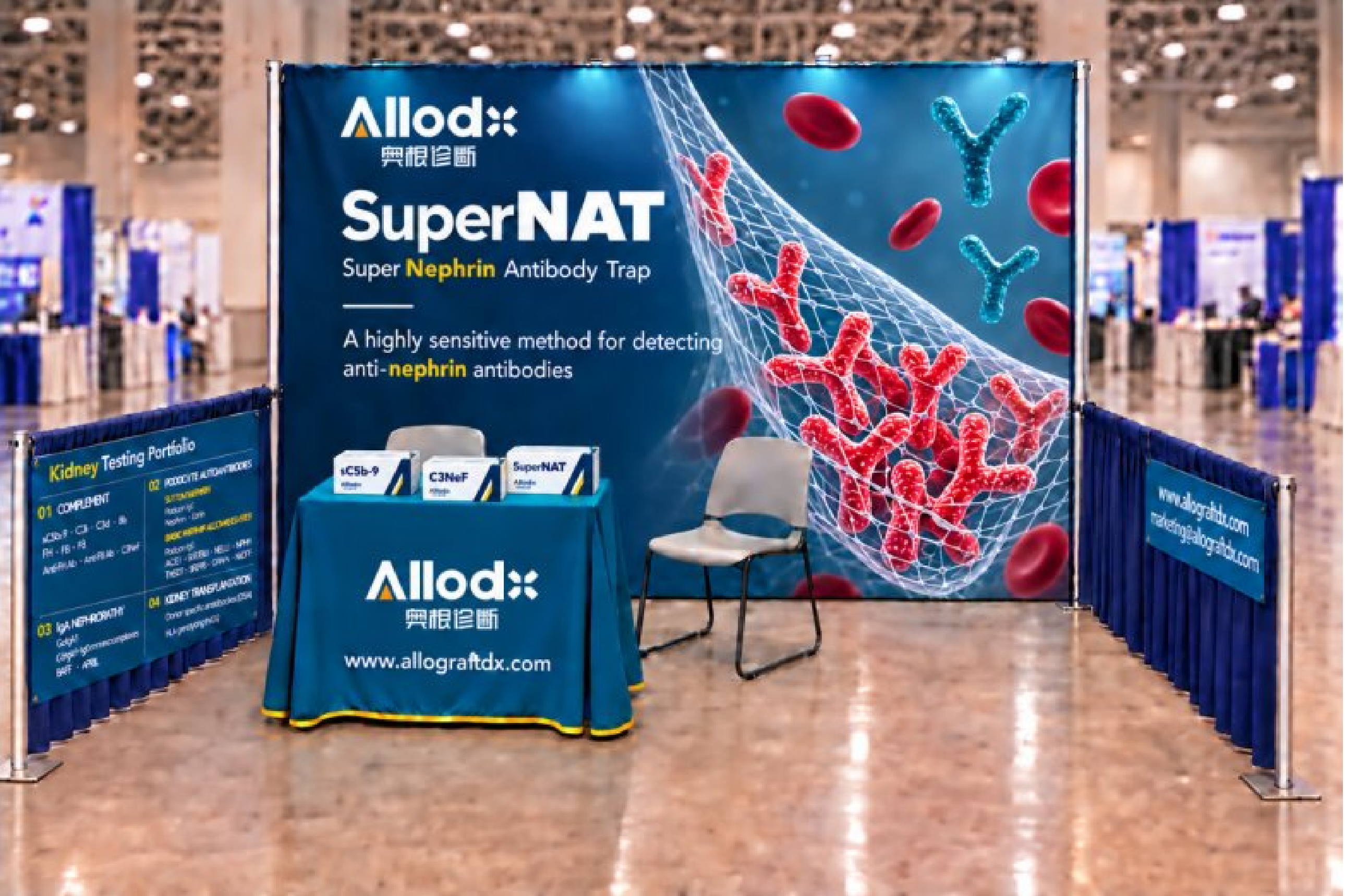
From capturing low-abundance autoantibodies and recognizing complement activation-specific epitopes to advancing quantitative assays with monoclonal antibody standards, kidney immunology research places increasing demands on assay technology: detecting and interpreting signals, while establishing a basis for comparable measurements.
On October 22–24, AlloDx will showcase three featured assay kits—for anti-Nephrin autoantibodies, sC5b-9 and C3NeF—at the ASN Kidney Week 2026 Scientific Exposition in Denver, USA. Visit the AlloDx team at the Colorado Convention Center, Hall A, Booth 991, to discuss advances in kidney immunology assays and research collaborations.
Building on its in-house assay methods and core antibody development, AlloDx serves advanced kidney research and specialist testing markets worldwide, focusing on recognition specificity, low-abundance detection and quantitative standardization across key measurement steps.
C3NeF: Advancing Quantitative Measurement with Recombinant Monoclonal Antibody Calibration
Further development of C3NeF assays requires a defined calibration relationship between assay signals and quantitative results. At this exhibition, AlloDx will highlight research into a quantitative magnetic bead assay using a recombinant C3NeF monoclonal antibody as the standard.
The method uses C3b-coupled magnetic beads as the reaction support. Background is controlled by subtracting signals between test and control wells; anti-human IgG then detects binding, and sample results are calculated using a monoclonal antibody standard curve. The monoclonal antibody standard provides a defined, reproducible source of calibration and a methodological basis for subsequent batch control and comparisons across research results.
The C3NeF assay technology developed by AlloDx supports a calibration series of 18.75–1200 ng/mL. Validation has addressed the standards, curve calibration and sample measurement to advance more standardized quantification of C3NeF. Assessment of convertase stabilization through Bb retained on magnetic beads and measurement of IgG binding provide complementary functional and immunological binding perspectives.
From standards to assay systems and from binding signals to function-related readouts, AlloDx focuses on developing measurement tools that support more informative interpretation in C3NeF research.
sC5b-9: AD99 Recognizes a C9 Neoepitope
A key aspect of measuring terminal complement activation is recognizing structural features that emerge after complex formation. At the core of the AlloDx sC5b-9 assay kit is the AD99 monoclonal antibody, which targets a conformational neoepitope of polymerized C9.
According to AlloDx research and development materials, the AD99 target epitope is formed jointly by adjacent C9 subunits at their conformational interface. This design focuses recognition on structural changes arising from complex assembly, rather than simply identifying an individual complement component.
In the two-antibody sandwich ELISA, AD99 serves as the capture antibody, while the detection antibody recognizes C5b. The paired readout targets distinct structural sites, placing the molecular structure being recognized at the center of assay design.
For AlloDx, core antibody development spans target epitope selection, antibody screening and assay construction. Based on AD99, the sC5b-9 product is intended for research into terminal complement activation, providing a measurement tool for studies of kidney disease mechanisms and complement interventions.
SuperNAT: Improving the Resolution of Low-Abundance Signals
Anti-Nephrin autoantibodies offer a new perspective in research on podocyte-associated diseases. To address low-abundance targets and complex sample backgrounds, SuperNAT (Super Nephrin Antibody Trap) combines magnetic bead capture, enrichment and washing, and background subtraction in a workflow designed to resolve target signals more clearly.
Magnetic bead capture and enrichment: Antigen–antibody binding and magnetic separation concentrate target antibodies in a measurable reaction system, supporting the detection of low-abundance antibodies.
Background subtraction and interference control: Background correction is incorporated into the readout. Existing research and development materials also describe interference assessments under hemolytic and high-triglyceride sample conditions, addressing the complexity of real samples.
Repeatability and longitudinal research: Data from the AlloDx research and development team show an intra-assay CV of 6.8% and an inter-assay CV of 10.4%, providing preliminary support for repeated measurements under the conditions tested. Longitudinal studies of changes in antibody levels may help further investigate relationships with disease phenotypes and progression.
SuperNAT detects anti-Nephrin autoantibodies. Through clearer target recognition and a more consistent assay workflow, AlloDx aims to support research into minimal change disease and related podocyte disorders, helping translate emerging biological discoveries into measurable and verifiable research practice.
Meet Us at ASN Kidney Week 2026
AlloDx has continued to invest in kidney immunology assays: improving resolution of low-abundance autoantibody signals with SuperNAT, targeting complement complex neoepitopes with AD99, and advancing C3NeF quantification through recombinant monoclonal antibody calibration.
To address the needs of advanced research worldwide, AlloDx looks forward to discussions with nephrology experts, research institutions and specialist partners on methodological validation, clinical sample studies and international collaboration.
October 22–24, 2026 · Denver, USA. AlloDx looks forward to welcoming you at Hall A · Booth 991.
 Read the original WeChat article (Chinese)
Original images retain their source language.