
AlloDx launches CompliTCC™ sC5b-9 test
AlloDx launches CompliTCC™ sC5b-9 test
AlloDx launches CompliTCC™ sC5b-9 test
——
AlloDx officially launches the AlloDx CompliTCC™ sC5b-9 ELISA Kit and supporting detection services for the quantitative detection of soluble terminal complement complex sC5b-9 in human EDTA plasma. The project uses the CompliTCC™ method (neo-epitope-specific double-antibody sandwich ELISA): AD99 captures the aggregated C9 conformation nascent epitope, and the detection antibody confirms the C5b domain, using dual structure recognition to improve selectivity for the complete complex.
Project | content |
Products/Services | AlloDx CompliTCC™ sC5b-9 ELISA Kit / Professional Testing Service |
methodology | CompliTCC™ method (neo-epitope-specific double-antibody sandwich ELISA) |
Recommended sample | K2 EDTA plasma |
linear range | 15.625–250 ng/mL |
Why choose EDTA plasma?
In clinical testing, the sample matrix is as important as the pre-analytical conditions and the antibodies themselves. The complement system may continue to be activated after ex vivo, especially as serum coagulation processes alter activation marker levels. Recent comparative studies on different blood collection tubes have shown that the degree of complement activation under various serum preparation conditions is higher than that of EDTA or lepirudin plasma. Therefore, when used to evaluate complement activation in vivo, serum and EDTA plasma should not be mixed, and dynamic follow-up should maintain the same sample type and the same processing flow.
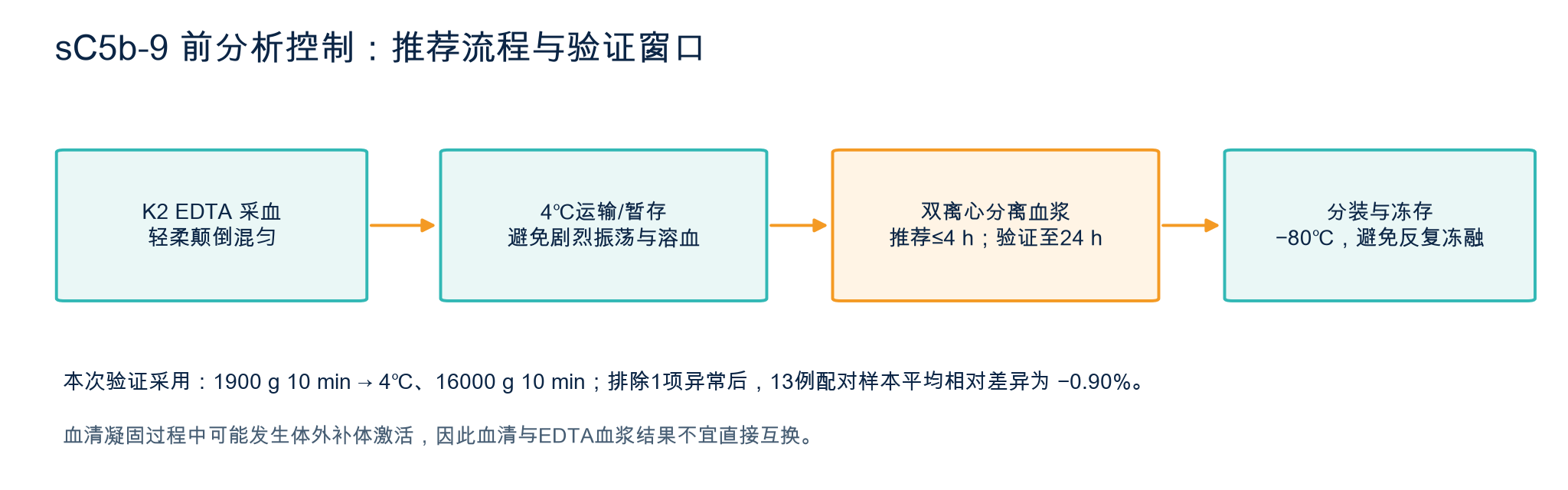
Figure 1 | Pre-recommendation analysis process. This real data verified the clinical delivery scenario of separation after 24 hours of storage at 4°C.
Sampling and shipping: Separating real changes from in vitro activation
AlloDx recommends priority collection of K2 EDTA anticoagulated blood. After blood collection, mix gently by inverting to avoid vigorous shaking and hemolysis; ideally, centrifuge as soon as possible and separate plasma within 4 hours. If samples need to be sent from the clinical center to the AlloDx laboratory, they can be transported cold chain at 2–8°C. This verification adopts the scenario of separation after 24 hours of storage at 4°C, and follows the double centrifugation process of 1900 g for 10 minutes and 4°C 16000 g for 10 minutes. Whole blood should not be frozen directly; the separated plasma should be packaged according to the single detection volume and stored at −80°C to reduce repeated freezing and thawing.
Two sets of real data: the impact of delayed separation is limited, and the overall change within one month at −80°C is limited
After excluding one abnormal 24-hour test confirmed by review, a total of 13 paired samples were included. The same K2 EDTA anticoagulated blood was separated within 4 hours after collection and after 24 hours of storage at 4°C. The average concentrations of the two groups were 628.18 ng/mL and 617.09 ng/mL respectively. The average difference was −11.10 ng/mL, and the average relative difference was −0.90%. The correlation coefficient between the two groups was r=0.9901. The results suggest that under the current sampling, centrifugation and detection conditions, separation after 24 hours of storage at 4°C has a limited overall impact on the detection results. Currently, 4 cases are included in the isolation group within 4 hours and 3 cases in the isolation group after 24 hours. Relative to D0, the average results of D30 in the two groups were 82.8% and 76.9% respectively, both showing a downward trend.
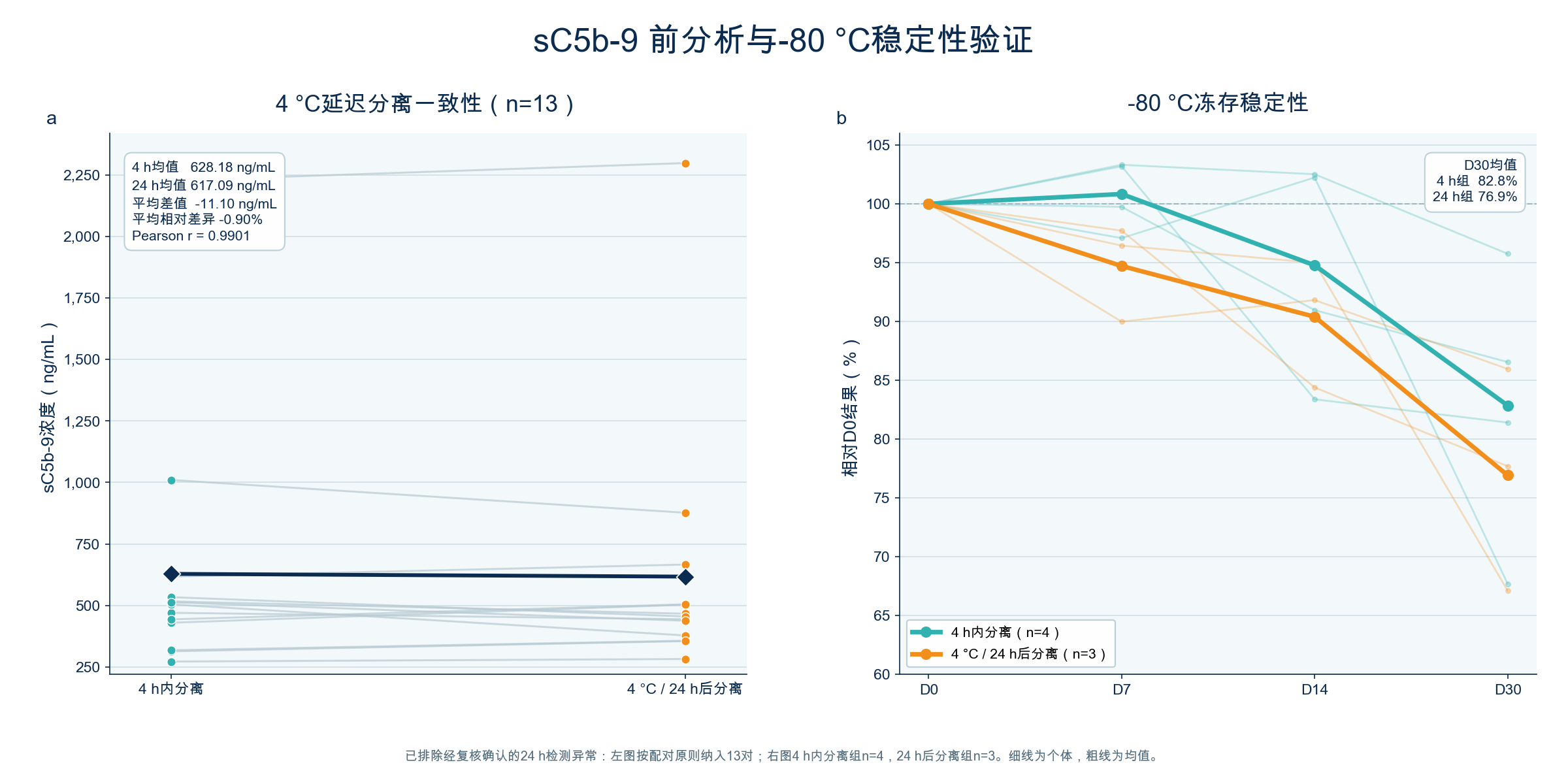
Figure 2 | Real experimental data. The left picture shows the paired comparison of 13 cases in absolute concentration (ng/mL) between separation within 4 hours and separation after storage at 4°C for 24 hours; the right picture shows the relative changes of plasma after storage at −80°C on D7, D14 and D30 under two separation conditions. The separation group within 4 hours n=4, and the separation group after 24 hours n=3.
data boundaries Delayed separation verification n=13; storage stability 4-hour group n=4, 24-hour group n=3. The current results support the preliminary judgment of "limited impact and limited overall change", which does not mean that all stability performance confirmation has been completed.
How do test results enter clinical judgment?
The clinical value of sC5b-9 is to reflect the complex formation after the three complement pathways converge into the terminal stage, and can assist in the assessment of terminal pathway activity, disease dynamics, and changes in the context of complement-targeted therapy. However, it cannot locate the initial pathway alone, nor can it make a diagnosis independently of clinical practice. AlloDx's testing services put method specificity, sampling specifications, cold chain transportation, sample stability and result interpretation into the same quality system. The goal is to make each test correspond to the real terminal complement activation in the patient as much as possible, rather than the technical noise generated after the sample is removed from the body.
References
1. Hugo F, Krämer S, Bhakdi S. Sensitive ELISA for C5b-9 and SC5b-9. J Immunol Methods. 1987;99:243-251. PMID: 3584995.
2. Complement function and activation in human serum and plasma collected in different blood collection tubes. J Immunol Methods. 2025; PMID: 39921078.
3. Wilson RJ, et al. Validation and performance of MicroVue sC5b-9 Plus ELISA. Clin Chim Acta. 2025; PMID: 39788342.
4. Horváth O, et al. Early increase in sC5b-9 predicts TA-TMA after stem cell transplantation. 2018; PMID: 29339271.
Some original figures, videos and downloadable materials are provided in Chinese.