
Genetic testing should not stop at finding mutations
Core point of view: Detecting variants is only the starting point; only by putting the variants back into the context of kidney disease and kidney transplantation can we form more clinically valuable information.
core ideas Detecting variants is only the starting point; putting the variants back into the context of kidney disease and kidney transplantation can lead to more clinically valuable information. |
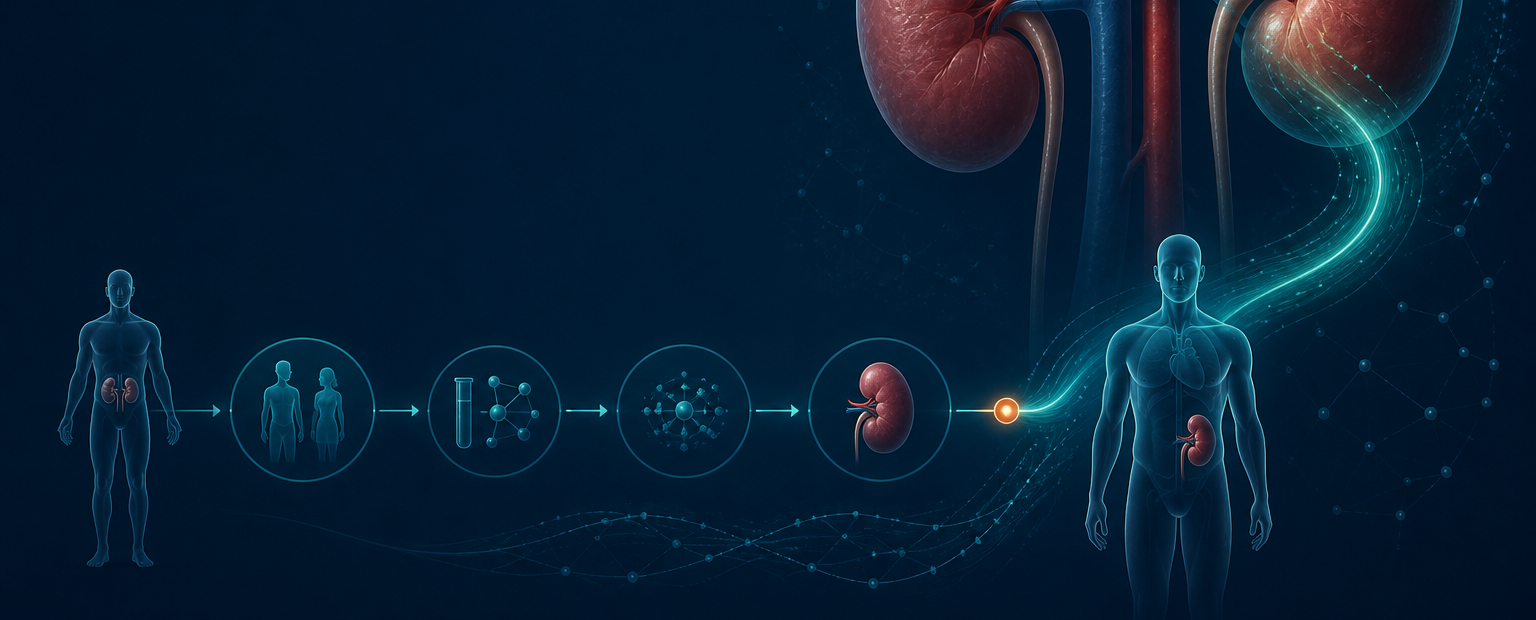
When a genetic test report lists the disease-causing gene, mutation site and pathogenicity grade, has it answered the questions that kidney disease patients really care about? For patients who are preparing for a kidney transplant, who are being evaluated for a related donor, or who develop abnormal renal function after transplantation, the answer is often no. Discovering mutations is only the starting point; only by putting the mutations back into the context of disease mechanisms, transplantation stages, and treatment scenarios can we generate clinically valuable information.
After widespread coverage, what else is needed clinically?
Currently, many genetic tests use one-size-fits-all modalities that cover a wide range of diseases and a large number of genes. This type of test is good at answering "what was detected": including which gene the variant is located in, whether it is pathogenic or suspected to be pathogenic, whether it is related to a certain type of genetic disease, and whether family verification is recommended. These contents are important for establishing molecular diagnosis, but general reports often stop at disease association and pathogenicity classification, and rarely go on to answer specialized questions of kidney disease patients.

The general report answers "what was detected", and the disease-specific interpretation further answers "what may be changed"
Kidney disease is markedly clinically heterogeneous. It also manifests as proteinuria, hematuria, decreased renal function or end-stage renal disease, which may involve glomerular, tubulointerstitial, cystic kidney disease, structural abnormalities, complement imbalance, metabolic deposition or systemic genetic diseases. For kidney transplant patients, further considerations need to be made: whether the original disease will relapse, whether the recipient's mutation affects the evaluation of related donors, whether kidney transplantation alone is appropriate, and whether postoperative abnormalities are more consistent with recurrence, immune damage, complement abnormalities, or other mechanisms.
Special disease interpretation, connecting three key clinical scenarios
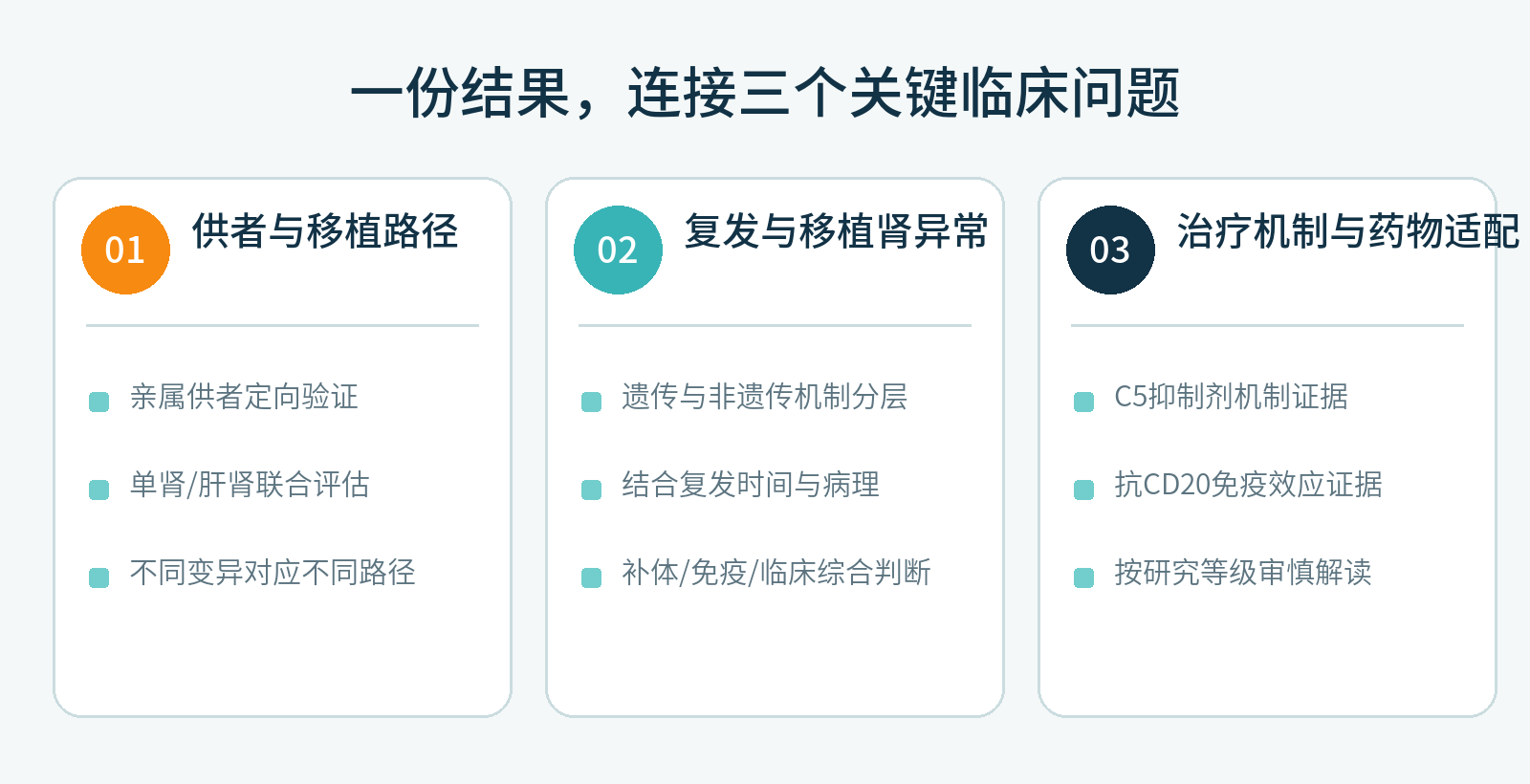
Establish stratified evidence around donors and transplant routes, postoperative recurrence, and treatment mechanisms
1. Genetic variation may affect donor selection and transplantation path
Different genes in the same disease, or even different types of mutations in the same gene, may correspond to different transplantation pathways. Taking primary hyperoxaluria as an example, AGXT, GRHPR, and HOGA1-related diseases have different organ involvement and metabolic load, and may require separate evaluation for kidney transplantation alone, combined liver-kidney transplantation, or sequential transplantation. Different variants of FGA hereditary amyloidosis may also affect the evaluation of transplantation options. When a clear pathogenic variant is found in the recipient, the report should also indicate whether the relative living donor needs to undergo targeted mutation verification, rather than just "recommending pedigree verification".
2. The risk of recurrence cannot be separated from the disease mechanism and timeline.
Recurrence of renal disease after surgery is not a single problem. Hereditary FSGS usually has different recurrence logic than non-hereditary FSGS; C3 glomerulopathy requires a combination of complement genes, autoantibodies, clinical indicators and pathology for mechanism stratification; although IgA nephropathy is not a typical single-gene genetic disease, it can still provide auxiliary information from the perspective of genetic susceptibility. Disease-specific interpretation should also search for evidence between mutations, disease mechanisms, recurrence time and transplantation outcomes to help the clinic form more targeted follow-up and identification ideas.
3. Extending from mutation results to treatment mechanism evidence
Generic reporting generally does not proactively extend to a drug's mechanism of action. Interpretation of kidney disease diseases can further focus on: whether C5-related variants may affect the binding or blocking mechanism of C5 inhibitors such as eculizumab; whether immune effect-related sites such as FCGR3A are related to differences in anti-CD20 monoclonal antibody responses. This type of information should be presented hierarchically according to functional evidence, clinical studies and exploratory findings, and should be used to provide evidence reference for drug suitability, rather than directly predicting efficacy or replacing clinical decision-making.
AlloDx: From a variant list to a clinical interpretation framework
Based on the above clinical needs, AlloDx has built a full-spectrum genetic testing and disease-specific interpretation system for hereditary kidney diseases. This differentiated capability is based on the long-term accumulation, continuous updating and manual verification of kidney disease-related genes, mutations, phenotypes, transplant outcomes, recurrence time and treatment evidence databases. It cannot be formed in the short term by expanding the detection panel or copying the report template. The value of AlloDx does not lie in simply increasing the number of genes, but in integrating patient phenotype, family history, disease mechanism, transplantation stage, donor relationship, recurrence time and treatment targets into the same framework, so that the test results can be integrated into six clinical scenarios - clarifying the molecular cause, donor and donor kidney risk adaptation, transplantation method and surgical strategy, perioperative risk management, recurrence risk and abnormal identification, and treatment mechanism and drug adaptation.
clinical positioning Genetic results are used to assist diagnosis, risk stratification and treatment mechanism analysis, and need to be comprehensively judged based on patient phenotype, pathology, immunological indicators and clinical processes. |
Some original figures, videos and downloadable materials are provided in Chinese.