
Prospective case: follow-up of a preoperative Nephrin antibody-positive patient after desensitization treatment
Recently, the magazine "Kidney International" reported a case of a pediatric patient with primary focal segmental glomerulosclerosis (pFSGS) who cleared Nephrin antibodies before kidney transplantation and no recurrence was observed after transplantation. (https://doi.org/10.1016/j.ki
Recently, the magazine "Kidney International" reported a case of a pediatric patient with primary focal segmental glomerulosclerosis (pFSGS) who cleared Nephrin antibodies before kidney transplantation and no recurrence was observed after transplantation. (https://doi.org/10.1016/j.kint.2025.04.015) pFSGS accounts for a high proportion of end-stage renal disease in children. The recurrence rate after kidney transplantation is as high as 30% (9–55%), and half of the transplanted kidneys lose function as a result. Multi-center retrospective studies from 2022 to 2024 successively found that the Nephrin antibody positivity rate in the FSGS recurrence group was 100%, and there was almost no recurrence in the antibody-negative group. However, at present, traditional strategies (intensive immunosuppression, plasma exchange) can only "salvage" FSGS after recurrence, and no team dares to actively remove antibodies before surgery and prospectively verify the efficacy.
In this case, this pediatric patient with pFSGS from the Pediatric Nephrology Center of the University Hospital Cologne, Germany, was scheduled to receive a priority kidney transplant only 10 months after the onset of the disease due to the rapid progression of the disease. In order to better assess the risk of FSGS recurrence, clinicians added Nephrin antibody testing to the pre-transplantation assessment. Immunoprecipitation, Western blot, and immunofluorescence methods were used for simultaneous dynamic testing. The results were all positive, so rituximab was used for treatment. Although CD19⁺B lymphocytes had been completely and continuously suppressed after two treatments, the Nephrin antibody level was still above the critical value after 3 weeks. The antibodies were subsequently cleared by plasma exchange with good results (Fig. 1a–c, Fig. 2). The patient subsequently underwent a living-donor kidney transplant, and the function of the transplanted kidney recovered immediately without complications.
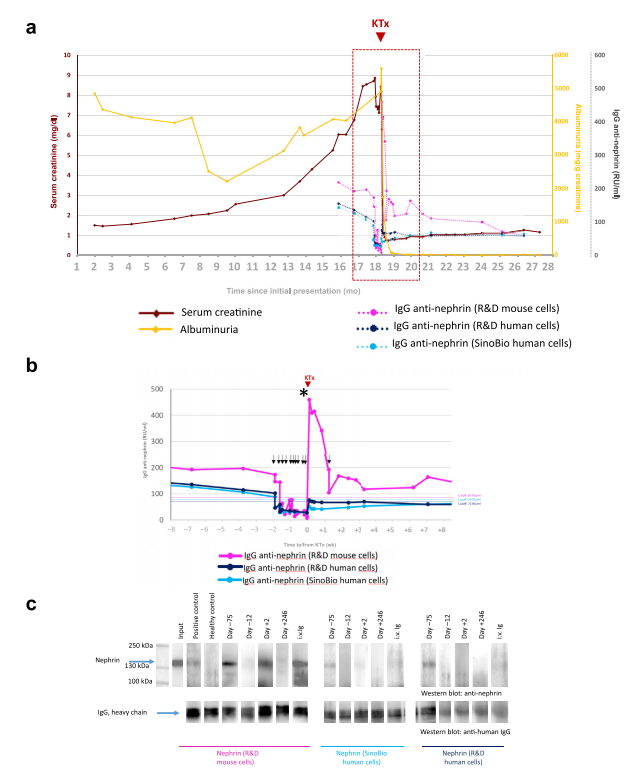
Figure 1
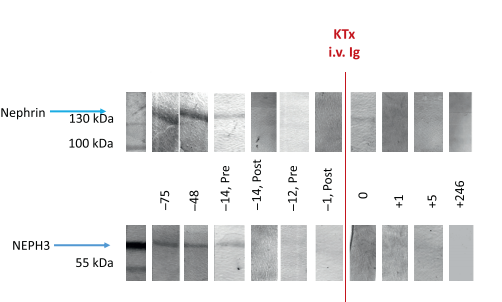
Figure 2
According to the recommendations of the International Society of Pediatric Nephrology on steroid-resistant nephrotic syndrome, in order to better monitor whether new proteinuria occurs after kidney transplantation, the patient's native kidney on the same side was clinically removed. Immunostaining analysis for Nephrin and IgG was performed on the initial renal biopsy and nephrectomy specimens. In well-preserved glomeruli, Nephrin showed discontinuous linear staining and co-localized with IgG, but the staining intensity was lower than that in the original kidney biopsy specimen (Figure 3). As of the current follow-up (more than one year after transplantation), the patient's transplanted kidney function has remained good and there is no proteinuria. All three detection methods show that the antibody level continues to be below the critical value (see Figure 1a).
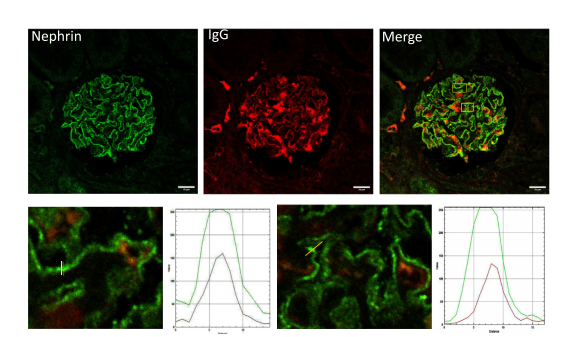
Figure 3
This case provides a preliminary basis for formulating a kidney transplant treatment plan for patients who are positive for Nephrin and other podocyte protein antibodies, and is of great significance for formulating a kidney transplant treatment process for patients with pFSGS. At the same time, it also highlights the complexity of Nephrin antibody detection in diagnosis. Since the Nephrin antibody content is extremely small, it is easily interfered by macromolecular proteins and background noise, and is also affected by factors such as the environment and operators. Taken together, the Nephrin antibody detection method based on antibody capture and enrichment pathways can improve the stability and reproducibility of Nephrin antibody detection. The Super Nephrin Antibody Trap (SuperNAT) second-generation highly sensitive Nephrin antibody detection solution developed by AlloDx, based on the antibody enrichment platform of SuperNAT technology, significantly reduces the background noise of Nephrin antibody detection and increases the detection rate by 53% compared with the traditional ELISA method.
Note: Teachers who are interested in this project and need to submit it for testing can contact the AlloDx medical representative in your city.
Some original figures, videos and downloadable materials are provided in Chinese.