
A Nature Portfolio Journal Cites the AlloDx Team's Early dd-cfDNA Research
Recently, the AlloDx team's early paper on the detection technology of kidney transplant donor-derived cell-free DNA (dd-cfDNA) was cited once by a Nature sub-journal published in May.
Recently, the AlloDx team's early paper on the detection technology of kidney transplant donor-derived cell-free DNA (dd-cfDNA) was cited once by a Nature sub-journal published in May.
AlloDx was among the early to perform kidney transplant donor-derived dd-cfDNA testing; related technical papers have been cited by international authoritative journals. Based on a next-generation sequencing platform and using the self-developed ID-Tag seq technology, by enriching cfDNA and reducing background noise, it lowers NGS background error by 1000-fold, achieving high-precision detection of one-in-a-thousand low-frequency mutations at ultra-high sequencing depth, captures and tests patient dd-cfDNA, and combines the bioinformatics quantitative model HQ-NIT to assess rejection severity.
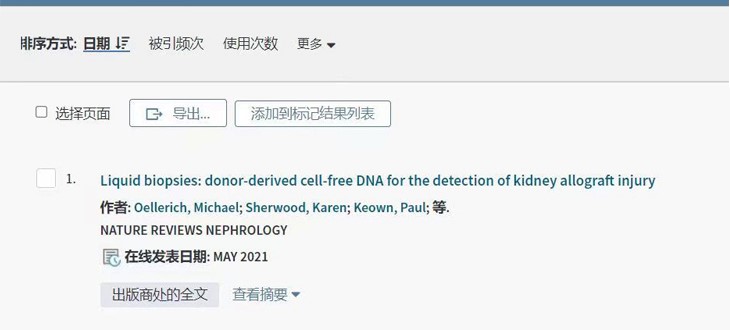
Nature is one of the world's longest-established and most prestigious scientific journals. Its mission is 'to show the public the important discoveries in scientific research and let the public know as early as possible the progress made in every branch of natural science worldwide.' Unlike most scientific journals today that focus on a single field, it publishes original research papers from many scientific disciplines. In many fields of scientific research, many important and frontier results are published in Nature as short communications.
Some original figures, videos and downloadable materials are provided in Chinese.