
Science Frontier: Regarding ddcfDNA, what was discussed at the ATC meeting? (2)
In the last issue, the editor introduced to you the new progress of transplant liquid biopsy (donor-derived cell-free DNA, ddcfDNA) at the ATC meeting. In this issue, the editor will continue to introduce it in detail.
In the last issue, the editor introduced to you the new progress of transplant liquid biopsy (donor-derived cell-free DNA, ddcfDNA) at the ATC meeting. In this issue, the editor will continue to introduce it in detail.
01
Gillespie M, Haas M, Lim K, Vo A, Peng A, Najjar R, Sethi S, Jordan S, Huang E. Donor-Derived Cell-Free DNA Combined with Histology Improves Prediction of eGFR Decline in Kidney Transplant Recipients over Histology Alone [abstract]. Am J Transplant. 2020; 20 (suppl 3).
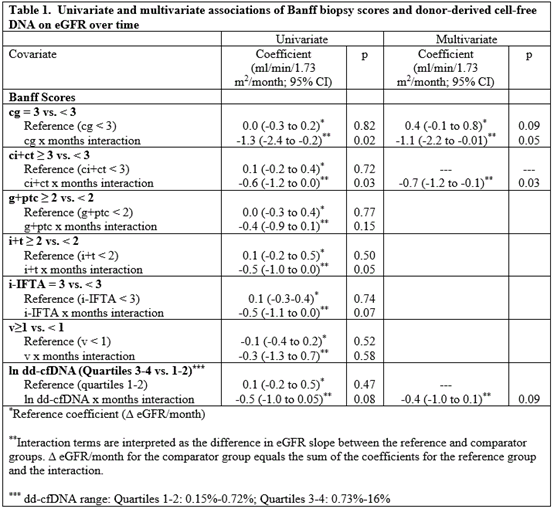
The degree of inflammation and chronic lesion score of puncture pathology results in patients with kidney transplants are related to graft survival, but the predictive value of the puncture pathology score alone is limited. Cedars-Sinai Medical Center investigated whether the ability to predict kidney transplant survival could be improved by building a predictive model integrating ddcfDNA and the Banff Bx score.
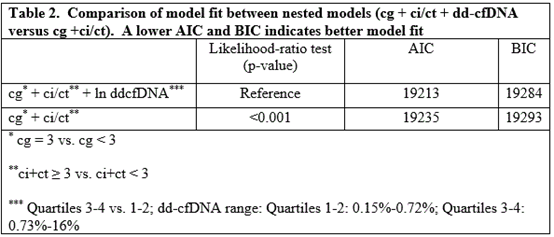
This study enrolled 185 transplant patients and detected Bx and ddcfDNA. The results showed that chronic lesion scores (cg=3 vs. cg<3, p=0.02 and ci+ct >/= 3 vs. ci+ct<3, p=0.03) by aspiration pathology were significant in predicting graft survival. However, the inflammation score (i, t, v) and i-IFTA score had no significant significance in predicting graft survival. In addition, ddcfDNA combined with i, t, v, and i-IFTA scores did not significantly change the prediction of graft survival. However, ddcfDNA combined with cg/ci+ct score was significantly better than cg/ci+ct score alone in predicting graft survival.
The results suggest that integrating ddcfDNA (rather than the inflammation score) with the chronic lesion score significantly improves the ability to predict graft survival.
02
Huang G, Chen X, Chen W, Chen P, Jiang T, Wang C, Chen L. Urine Donor Derived Cell Free DNA Aids in the Diagnosis of BK Polyomavirus Nephropathy in Kidney Transplant Recipients with BK Viruria [abstract]. Am J Transplant. 2020; 20 (suppl 3).
BK virus-related nephropathy (BKVN) is one of the important causes of renal transplant dysfunction and graft failure, but its clinical manifestations lack specificity. Pathologically, both acute T cell-mediated rejection (TCMR) and acute T cell-mediated rejection (TCMR) manifest as renal tubular and interstitial inflammation. The Kidney Transplant Center of the First Affiliated Hospital of Sun Yat-sen University studied the role of ddcfDNA in differentiating BKVN and TCMR.
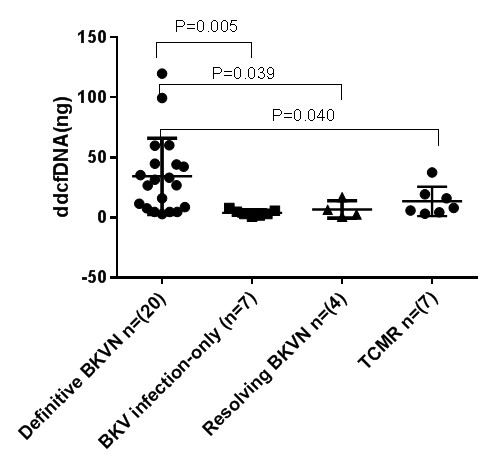
This study enrolled 38 patients, including 20 patients with BKVN (Definitive BKVN), 7 patients with BKV-infection only, 4 patients with BKVN treatment (Resolving BKVN), and 7 patients with TCMR. The content of ddcfDNA in hematuria was detected by target region hybridization capture sequencing. The results showed that the absolute value of ddcfDNA in the urine of the BKVN group was significantly higher than that of the simple BKV infection group (p=0.005), the remission group after BKVN treatment (p=0.039) and the TCMR group (p=0.040). It is suggested that ddcfDNA in urine can be used to distinguish BKVN and TCMR patients.
03
Sureshkumar KK, Chopra B. Impact of Kidney Transplant Type and Previous Transplant on Baseline Donor-Derived Cell Free DNA [abstract]. Am J Transplant. 2020; 20 (suppl 3).
Experts from Allegheny General Hospital's Transplant Center studied the impact of different kidney transplant types on ddcfDNA testing.
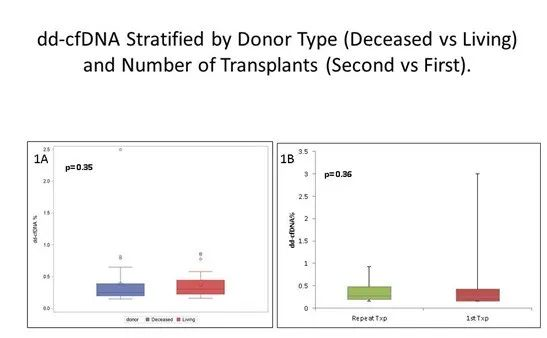
This study enrolled 72 kidney transplant patients (all without rejection), of whom 60 were first-time transplant patients: 32 were cadaveric kidney transplants, 28 were living donor transplants, and 12 were repeat transplant patients. The results showed that there was no significant difference in the ddcfDNA detection values between cadaveric kidney transplantation and living donor transplantation (0.39±0.42 vs. 0.37±0.20, p=0.35) or first transplantation and repeated transplantation (0.34±0.07 vs. 0.39±0.43, p=0.36).
The results showed that the lost transplanted kidney had no significant impact on the ddcfDNA detection value. In addition, although cadaveric kidney transplantation is affected by ischemia-reperfusion, immune mismatch, etc., there is no significant difference in ddcfDNA detection values between cadaveric kidney transplantation and living donor transplantation.
04
Steggerda J, Pizzo HPhan, Garrison J, Zhang X, Haas M, Kim I, Jordan S, Puliyanda D. Use of Donor-Derived Cell-Free DNA Assay to Monitor Treatment Response to Allograft Rejection in Pediatric Renal Transplant Recipients [abstract]. Am J Transplant. 2020; 20 (suppl 3).
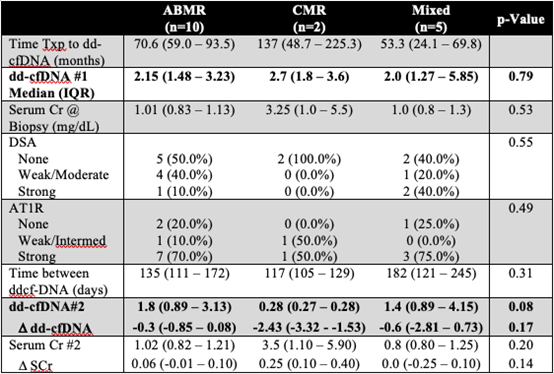
Among pediatric kidney transplant patients, acute rejection (AR) causes graft failure in 13%-20% of cases, and graft failure accounts for 45.8% within 10 years. Therefore, early detection and optimization of treatment options are crucial. Experts at Cedars Sinai Medical Center studied the role of ddcfDNA in assessing the effectiveness of rejection treatment in pediatric kidney transplant patients.
This study enrolled 58 pediatric kidney transplant patients, and 18 (31%) patients had a ddcfDNA detection value >1%. Among them, 17 (94.4%) patients were diagnosed with pathological manifestations of rejection through biopsy. There were 10 cases of antibody-mediated rejection (ABMR), 2 cases of TCMR, and 5 cases of ABMR combined with TCMR. Serum creatinine was at normal levels at the time of biopsy (1.00 mg/dL, IQR 0.87-1.15 mg/dL), changed slightly after treatment, and was not significantly associated with ddcfDNA (p=0.65). After rejection treatment, ddcfDNA decreased in all groups, but the ddcfDNA detection values in the ABMR group and ABMR/TCMR group were still higher than 1%.
The results suggest that ddcfDNA can early diagnose rejection in pediatric kidney transplant patients (despite stable creatinine), and the diagnostic effect is reliable in TCMR.
05
Teuteberg J, Krim S, Shullo M, Jimenez S, Eisen H. Donor-Derived Cell-Free DNA is Not Influenced by Steroid Dosing in Heart Transplant Recipients [abstract]. Am J Transplant. 2020; 20 (suppl 3).
Gene expression profiling (GEP) has been approved for monitoring the occurrence of rejection in heart transplant patients, but it can only be used after 55 days after surgery. In addition, GEP scores may be falsely low when steroid doses exceed 20 mg. ddcfDNA detection is less limited by the time after transplantation and is not affected by steroid drug use. Transplant centers such as Stanford University have systematically studied the impact of steroid use on ddcfDNA.
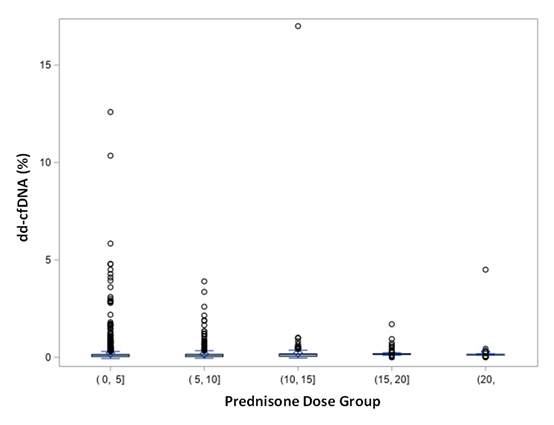
This study analyzed 816 adult heart transplant patients in the DOAR/SHORE database, with a total of 1970 samples. There was no significant difference in the median detection values of ddcfDNA (0.12%, 0.12%, 0.15%, 0.15% and 0.15) at different steroid dosages (0-5, 5-10, 10-15, 15-20 and >20mg/day) (p=0.0813). In addition, according to the postoperative time, it was divided into early group (<55 days) and late group (55-90 days). The results showed that the difference in ddcfDNA detection values between early group (IQR: [0.15%, 0.19%]) and late group (IQR: [0.15%, 0.15%]) was not statistically significant (p=0.7754).
The results indicate that the detection of ddcfDNA is not affected by steroid drugs, and the post-operative detection time (around 55 days) has no impact on the detection of ddcfDNA.
In the next issue, the editor will continue to discuss with you the research and application of ddcfDNA in the field of transplantation.
Some original figures, videos and downloadable materials are provided in Chinese.